Monday, June 5, 2023

Panzer-Abteilung 65 Officer in France 1940


This photo was taken by Kriegsberichter Erich Borchert and it shows officers from the 6. Panzer-Division having a discussion during the military campaign in France, summer of 1940. Behind them is a medium tank of the Czechoslovakian-made Panzer 35(t) type. Standing in the center wearing the kradmantel is Major Hans-Karl Schenck (Kommandeur Panzer-Abteilung 65), while pointing beside him is Hauptmann Erich Löwe (Chef 3.Kompanie / Panzer-Abteilung 65). The book "Panzer-Regiment 11 / Panzer-Abteilung 65 1937-1945" by Michael Schadewitz (page 162) mentioned that on June 12, 1940 - in the middle of the advance of German troops in France and for unknown reasons - Major Schneck was withdrawn from the front and was replaced by Major Theodor Kretschmer. Schenck himself was later transferred to become Commander of the Panzertruppenschule, a position that was "less exciting" for a combat soldier! For his services in completely capturing a strategic bridge on the Oise canal, capturing French 9th Army staff officers at La Catelet and capturing the village of Doullens from enemy hands, Hauptmann Löwe was awarded the prestigious Ritterkreuz des Eisernen Kreuzes medal on 4 September 1940.


Source :
Bundesarchiv Bild 101I-769-0236-27
"Allied-Axis" issue 10 - Sturmgeschütz at the Front
https://it.wikipedia.org/wiki/6._Panzer-Division
https://www.tracesofwar.com/persons/11402/L%C3%B6we-Erich.htm

Sunday, May 7, 2023

The surrender of Panzer-Brigade Norwegen to British and Norwegian troops in Norway (June 1945)


Mute edited footage originally shot by US Signal Corps cameramen showing men serving with Panzer-Brigade-Norwegen handing over their tanks and  self-propelled guns to British army and Norwegian MILORG personnel  in the Akershus district outside Oslo circa 10 June 1945 following the unconditional surrender of all German forces in Norway the previous month.

The location is Trandum, the site of a former Norwegian Army training camp. The British officer seen taking the surrender of the commanding officer of Panzer-Brigade-Norwegen (and his adjutant) has been identified as Lt-Colonel O J O'Connor.

The tanks seen in this film are late-mark  Panzer III medium tanks armed with either short-barrelled 7.5cm L/24 cannon or the long-barrelled 5cm L/60 cannon and have been fitted with "Schuetzen"  8mm armour plates as protection for their turrets and also in several instances seen here to their hull sides against hollow-charge projectiles. By 1945, the Panzer III was regarded as obsolete by German panzer commanders but no doubt the German garrison in Norway, denied access to more powerful tanks by the Nazi high command on the grounds they were needed on war fronts where combat was taking place, found their presence in its order of battle reassuring.

Many Panzer IIIs and a smaller number of Sturmgeschutz III 7.5cm assault guns were re-acrivated for use by Norwegian armoured units in 1948 and they remained in  service until their replacement by US M24 Chaffee light tanks in 1951.

The brigade commander, Oberst Georg Maetschke, can be seen at 1:57.


Source :
Simon Orchard photo collection
https://www.wehrmacht-awards.com/forums/forum/wehrmacht-uniforms-and-equipment/achtung-panzer-forum/13839620-the-surrender-of-german-panzers-to-british-and-norwegian-troops-in-norway-june-1945
https://www.youtube.com/watch?v=qVEnteNh2OU

Sunday, April 9, 2023

German Tanks in the Belgium Countryside

Western campaign, advance. tanks with mounted crew (wearing protective caps a.k.a. panzer beret) in the West (Belgium). The picture was taken in May 1940 by Kriegsberichter Wanderer of KBK Lw 4 (Kriegsberichter-Kompanie Luftwaffe 4).

Source :
Bundesarchiv Bild 101I-382-0250-02

Sunday, April 2, 2023

Wiking Panzergrenadiers in Kovel

Heroic battle for Kovel: German medium tanks entered a village held by the Bolsheviks and knocked out the Soviets. now the SS-Panzergrenadiers of the 5. SS-Panzer--Division "Wiking" push up to break the Bolshevik encirclement. The picture was taken in the early spring 1944.


Source :
https://beeldbankwo2.nl/nl/beelden/?q=panzer&mode=gallery&view=horizontal

Tuesday, March 28, 2023

The Battle of Kasserine Pass

This picture was taken by Kriegsberichter Seinig, and it shows German Panzer IIIs of 10. Panzer-Division in the Battle of the Kasserine Pass.  The Battle of Kasserine Pass was a significant military engagement during World War II that took place in the Kasserine Pass, located in western Tunisia, in February 1943. The battle was fought between German and Italian forces under the command of Field Marshal Erwin Rommel, and the Allied forces of the United States, led by General Lloyd Fredendall. The battle began on February 14, 1943, when the German forces launched a surprise attack on the US troops, catching them off guard and causing chaos and confusion. The inexperienced US soldiers were outmatched by the experienced German troops and suffered heavy casualties as they were pushed back. Over the next several days, the Germans continued their advance, and it seemed as though the Allies would be defeated. However, General George Patton was brought in to take command of the situation, and he immediately set about reorganizing the US forces and implementing new tactics. Under Patton's leadership, the US forces were able to turn the tide of the battle. They began to make progress against the German forces and were eventually able to push them back, securing a victory for the Allies. Although the Allied forces suffered significant losses during the battle, it was a turning point in the war and marked the first major defeat of the Germans in North Africa. The Battle of Kasserine Pass highlighted the importance of leadership, tactics, and experience in warfare, and it demonstrated the need for the Allies to improve their military capabilities in order to defeat the Axis powers.

Source :
https://biaarma.com/post/the-battle-of-kasserine-pass-and-the-failure-of-general-lloyd-fredendall

Sunday, March 19, 2023

Kampfgruppe von Strachwitz (March-April 1944)


"Kampfgruppe von Strachwitz" - part of Heeresgruppe Nord - had different elements through March and April 1944. At that time, Strachwitz was also "Höherer Panzerführer bei der Heeresgruppe", and his task was keeping the few Panzers and Panzergrenadier companies together in counterattacks. In March 1944, Panzerverband Strachwitz was given to the 11. Infanterie-Division. In April 1944, it was given to the 61. Infanterie-Division and the 122. Infanterie-Division.

Panzergruppe Strachwitz contained ad-hoc units as follow:
V.Abteilung / Panzer-Regiment "Großdeutschland" (Tigers)
Panzer-Abteilung Feldherrnhalle (5 Panzer IV)
Füsilier-Bataillon. 61
Füsilier-Bataillon 122
III.Bataillon / Grenadier-Regiment 410
Pionier-Bataillon 122
2.Kompanie / schwere-Panzer-Abteilung 502
1.Kompanie / Pionier-Bataillon 652
1.Kompanie / Pionier-Bataillon 676

From KTB (Kriegstagebuch) XXXXIII. Armeekorps:
19.03.1944 10:45 p.m : Oberst Graf Strachwitz will be assigned to Gen.Kdo. [XXXXIII.A.K.] as adviser on tank and assault gun deployment for the upcoming attack.
02.04.1944 12:00 p.m : As part of the preparations for the attack, Gen.Kdo. [XXXXIII.A.K.] from III./Gren.Rgt.410, Pi.Btl.122, 2./s.Pz.Abt.502, V./Grossdeutschland and parts of the Pz.Gren.Div.Feldherrnhalle formed the "Panzerverband Oberst Graf Strachwitz".


Source :
ECPAD archive photo collection
KTB XXXXIII.A.K. NARA T314, roll 1017
https://www.feldgrau.net/forum/viewtopic.php?t=27053
https://forum.axishistory.com/viewtopic.php?t=104857
https://imagesdefense.gouv.fr/fr/

Sunday, March 12, 2023

Three German Panzer Soldiers in a French Beach


Three Panzermänner - possibly from 7. Panzer-Division - on a newly conquered French beach. The picture was taken by Kriegsberichter Heinz Boesig of PK (Propaganda-Kompanie) 698 in May-June 1940.

Source :
Bundesarchiv Bild 101I-126-0316-21A

Friday, March 10, 2023

Michael Wittmann with His Tank Commanders


Panzer ace Michael Wittmann with his men from 2.Kompanie / Schwere SS-Panzer-Abtailung 101 during training in Northern France, May 1944. From left to right: SS-Unterscharführer Kurt Kleber (Tiger "232"), SS-Hauptscharführer Hans Höflinger (Tiger "213"), SS -Oberscharführer Georg Lötzsch (Tiger "233"), SS-Obersturmführer Michael Wittmann (Chef 2.Kompanie. Tiger "205"), SS-Unterscharführer Karl-Heinz Warmbrunn (Tiger "214"), and SS-Unterscharführer Balthasar "Bobby" Woll (Tiger "212"). They were all tank commanders in the second company and - with the exception of Kompaniechef Wittmann - all of them wore camouflage uniforms of the new SS-Erbsenmuster type (pea-dot pattern). The picture was taken by Kriegsberichter Scheck of PK (Propaganda-Kompanie) 698.


From left to right: SS-Obersturmführer Michael Wittmann (Chef 2.Kompanie / schwere SS-Panzer-Abteilung 101. Tiger "205"), SS-Unterscharführer Karl-Heinz Warmbrunn (blocked by Wittmann, Tiger "214"), SS-Hauptscharführer Hans Höflinger (Tiger "213"), SS-Oberscharführer Georg Lötzsch (Tiger "233"), SS-Unterscharführer Balthasar "Bobby" Woll (Tiger "212"), and SS-Unterscharführer Kurt Kleber (tidak terlihat disini, Tiger "232").


Source :
http://alifrafikkhan.blogspot.com/2012/08/album-foto-michael-wittmann.html
https://commons.wikimedia.org/wiki/File:Bundesarchiv_Bild_101I-299-1802-05,_Nordfrankreich,_Michael_Wittmann,_Panzersoldaten.jpg

Sunday, March 5, 2023

Panzer IV of 2. Panzer-Division during Training in the West 1940


Panzerkampfwagen IV Ausf.D with Crew of 5.Kompanie / II.Abteilung / 2.Panzer-Division during training in the West, 21 March 1940. In the Fall Gelb (German invasion of France and Low Countries), 2. Panzer-Division consisted of two panzer regiments (15 and 31), part of Panzer-Brigade 8. The picture was taken by Kriegsberichter Huschke of PK (Propaganda-Kompanie) 698.

Source :
https://commons.wikimedia.org/wiki/File:Bundesarchiv_Bild_101I-124-0216-11,_Im_Westen,_Panzer_IV.jpg
https://id.pinterest.com/pin/9077636727409850/

Tuesday, January 17, 2023

Bio of Hans-Detloff von Cossel of Panzer-Regiment 35


Johann-Detloff "Hans" Eberhardt Magnus von Cossel

Date of birth : 1 July 1916 (Swakopmund, German South-Western Africa)
Date of death : 22 July 1943 (Kromy, Orel, Soviet Union)

Promotions:
00.00.1934 Fahnenjunker
00.00.1935 Fähnrich
00.00.1936 Oberfähnrich
01.04.1937 Leutnant
01.10.1939 Oberleutnant
01.03.1942 Hauptmann
01.05.1943 Major

Career:
06.04.1934 Completed basic training in Reiter-Regiment 6
00.00.193_ Transferred to Reiter-Regiment 7 (reorganized as Panzer Regiment 2 in 1935)
10.11.1938 Zugführer in 6.Kompanie / Panzer-Regiment 35
01.04.1939 Führer 6.Kompanie / Panzer-Regiment 35
00.09.1939 Seriously wounded during the campaign in Poland
00.07.1941 Chef 6.Kompanie / Panzer-Regiment 35
04.07.1941 Seriously wounded during the campaign in Russia and flown to Berlin hospital
23.07.1941 Returned to his unit
00.09.1941 Wounded during the Battle of Kiev. His wounds were so severe that he was not able to return to his unit until spring of 1942
01.11.1942 Führer I.Abteilung / Panzer-Regiment 35
01.01.1943 Kommandeur I.Abteilung / Panzer-Regiment 35
21.07.1943 Kommandeur Kampfgruppe "Von Cossel"
22.07.1943 Fatally hit by bombs from Soviet bombers during counter attack

Awards and Decorations:
00.09.1939 Verwundetenabzeichen in Schwarz
22.09.1939 Eisernes Kreuz II.Klasse
20.12.1939 Eisernes Kreuz I.Klasse
00.00.19__ Dienstauszeichnung der Wehrmacht IV.Klasse
00.00.194_ Panzerkampfabzeichen in Silber
00.00.194_ Verwundetenabzeichen in Silber
19.08.1941 Ehrenblattspange des Heeres und Waffen-SS #237
08.09.1941 Ritterkreuz des Eisernen Kreuzes, as Oberleutnant and Führer 1.Kompanie / I.Abteilung / Panzer-Regiment 35 / 4.Panzer-Division
00.12.1941 Verwundetenabzeichen in Gold
00.00.1942 Medaille "Winterschlacht im Osten 1941/42" (Ostmedaille)
05.05.1943 Deutsches Kreuz in Gold
29.08.1943 Ritterkreuz des Eisernen Kreuzes mit Eichenlaub #285 (posthumously), as Major and Kommandeur I.Abteilung / Panzer-Regiment 35 / 4.Panzer-Division


Source :
Jim Haley photo collection
https://www.forum-der-wehrmacht.de/index.php?thread/41920-ritterkreuztr%C3%A4ger-cossel/
https://www.google.com/url?sa=t&rct=j&q=&esrc=s&source=web&cd=&cad=rja&uact=8&ved=2ahUKEwjptPL13878AhWnSmwGHZrYBUQQFnoECCkQAQ&url=http%3A%2F%2Fwww.ritterkreuztraeger.info%2Frkel%2Fc%2FEL285Cossel.pdf&usg=AOvVaw1xKONdegz6SHERR4C-d-Zc
https://www.lexikon-der-wehrmacht.de/Personenregister/C/CosselJDv.htm
http://www.mediafire.com/?8v47wshl6aiki
https://www.tracesofwar.com/persons/3218/Cossel-von-Johann-Dettleff-Hans-Detloff.htm
http://voncossel.blogspot.com/

Monday, December 26, 2022

Panzer IVs Before Operation Barbarossa


Two German Panzer IVs moving towards the German-Soviet demarcation line on 21 June 1941, less than 24 hours away before the start of Unternehmen Barbarossa, German invasion of Russia. In the foreground road sign "Grenze 1 km". For the campaign against the Soviet Union, the Germans allotted almost 150 divisions containing a total of about three million men. Among those units were 19 panzer divisions, and in total the Barbarossa force had about 3,000 tanks, 7,000 artillery pieces, and 2,500 aircraft.

Source :
https://9gag.com/gag/ajgVB0Q
https://en.topwar.ru/188854-21-ijunja-stalin-dilemma-prinjatija-reshenija.html
https://en.wikipedia.org/wiki/Operation_Barbarossa

Saturday, November 12, 2022

Inspection of 3. Panzer-Division at Wünsdorf

On 20 October 1935, 3. Panzer-Division - one of the first newly established armored units of the Wehrmacht - move into their new garrison in Wünsdorf, near Berlin. Generalleutnant Ernst Feßmann (second from left, Divisionskommandeur) inspecting the troops in the barracks courtyard. At left is Oberst Friedrich Paulus (Chef des Generalstabes beim Kommando der Panzertruppen).
 
Source :
https://www.alamy.com/stock-photo-armored-units-of-the-defense-force-in-wuensdorf-1935-37000225.html?imageid=2882B9A0-0ED9-47FF-A421-AC380ECEE05B&p=291611&pn=1&searchId=e7c7da064944a6d0d79490be072b3f72&searchtype=0
https://commons.wikimedia.org/wiki/File:Bundesarchiv_Bild_183-2006-1023-502,_W%C3%BCnsdorf,_General_Fessmann_schreitet_die_Front_ab.jpg

Tuesday, October 25, 2022

German Tanks Near Moscow


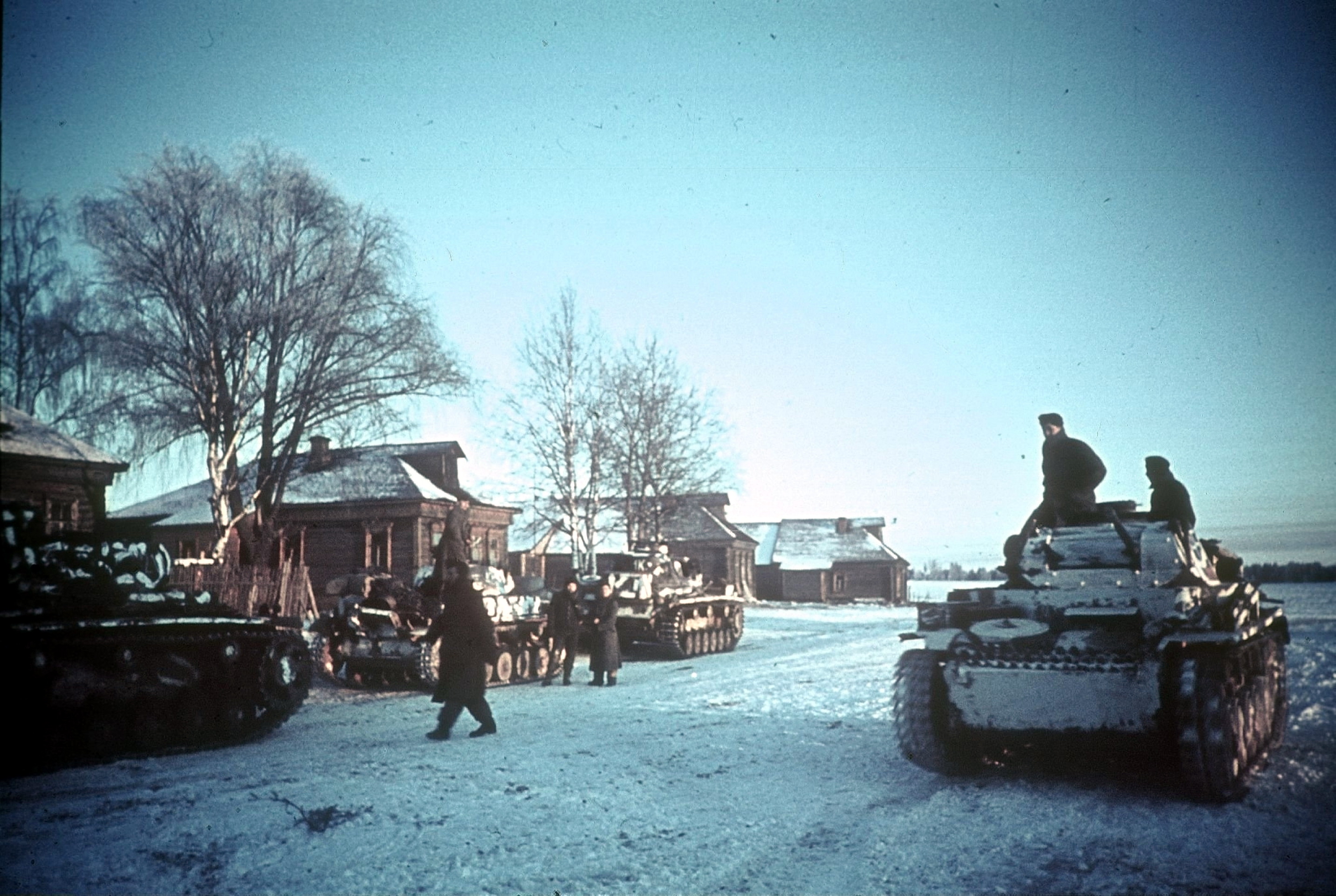
White winter camouflaged tanks of the 11. Panzer-Division in the village of Matronino near Volokolamsk. On the left, the first and third are Panzer III tanks, while between them and on the right is Panzer II tanks. The picture was taken by Kriegsberichter Artur Grimm in Moscow area, November 1941. From 31 October to 13–15 November 1941, the Wehrmacht high command stood down while preparing to launch a second offensive towards Moscow. Although Heeresgruppe Mitte (Army Group Centre) still possessed considerable nominal strength, its fighting capabilities had thoroughly diminished because of wear and fatigue. While the Germans were aware of the continuous influx of Soviet reinforcements from the east as well as the presence of large reserves, given the tremendous Soviet casualties, they did not expect the Soviets to be able to mount a determined defense.

Source :
https://en.topwar.ru/189069-tanki-shli-naprolom-podvigu-geroev-panfilovcev-80-let.html
https://en.wikipedia.org/wiki/Battle_of_Moscow

Sunday, October 23, 2022

Panzer IV Before Fall Gelb


Panzer IV Ausf.D in the Western Front before Fall Gelb, 21 March 1940. The picture was taken by Kriegsberichter Huschke from PK (Propaganda-Kompanie) 689. Despite increased production of the medium Panzer IIIs and IVs prior to the German invasion of France on 10 May 1940, the majority of German tanks were still light types. According to Heinz Guderian, the Wehrmacht invaded France with 523 Panzer Is, 955 Panzer IIs, 349 Panzer IIIs, 278 Panzer IVs, 106 Panzer 35(t)s and 228 Panzer 38(t)s. Through the use of tactical radios and superior tactics, the Germans were able to outmaneuver and defeat French and British armour. However, Panzer IVs armed with the KwK 37 L/24 75-millimetre (2.95 in) tank gun found it difficult to engage French tanks such as the Somua S35 and Char B1. The Somua S35 had a maximum armour thickness of 55 mm (2.2 in), while the KwK 37 L/24 could only penetrate 43 mm (1.7 in) at a range of 700 m (2,300 ft). The British Matilda II was also heavily armoured, with at least 70 mm (2.76 in) of steel on the front and turret and a minimum of 65 mm on the sides, but were few in number.

Source :
https://commons.wikimedia.org/wiki/File:Bundesarchiv_Bild_101I-124-0216-11,_Im_Westen,_Panzer_IV.jpg
https://en.wikipedia.org/wiki/Panzer_IV

Saturday, October 22, 2022

Panzers of Afrikakorps in Tripoli


Panzer IV Ausf.D and Panzer II tanks in Tripoli, Libya, March 1941. Note the big storage box at the back of the turret. Rommel arrived in North Africa in February 1941 with fairly mundane orders to act as a Sperrband, a “blocker” to bolster the Italians after their mauling at Beda Fomm. The force he led was appropriately tiny:  the reconnaissance battalion and an antitank detachment of the 5. leichte-Division (soon renamed the 21. Panzer-Division). The rest of the division was still en route to Africa, and a second division, the 15. Panzer-Division, would not arrive completely until the end of May 1941.

Source ;
"Deutsche Afrikakorps (1941-1943)" by Ricardo Recio Cardona
https://www.nationalww2museum.org/war/articles/drive-nowhere-myth-afrika-korps-1941-43

Tuesday, October 11, 2022

German Tanks in the Night


The German tanks fighting against Soviet tanks. A rocket flare in the night. Undated photograph, taken by photographer Artur Grimm and published by 'Signal' 19/1942.

Source :
'Signal' magazine 19/1942

Sunday, October 9, 2022

German Panzer Strength in the Operation Barbarossa


German Panzer III tank on the advance in the Ukraine during Operation Barbarossa, summer 1941. Photographer: Artur Grimm.

There are some that believe the sheer numerical superiority of the Red Army and Allies doomed Germany to defeat less than two years after continent wide war resumed in Europe late in 1939. For instance, the vast majority of David Stahel's decade long work posits that the Wehrmacht in general, but the German army (Heer) in particular, had shot their bolt as early as August of 1941. In assessing such claims this article will take a look at the primary component of the German army's striking power - it's panzer divisions. More to the point, I shall examine the state of the tank complement in those panzer divisions assigned to Operation Barbarossa (the June 1941 German invasion of the Soviet Union) after the campaign's first three months. In doing so, I hope to highlight one of many elements (for instance manpower losses in the infantry divisions would be another) that taken together can help readers understand for themselves whether or not the Ostheer (German army in the east) was beyond repair early in the fall of 1941.

The panzer divisions ready to invade the Soviet Union late in June 1941 were at that time the most powerful combined arms organizations in the world. For that matter, the quality of the armor fleshing out those panzer divisions had taken a quantum leap over that of the previous year. Whereas more than half the panzers deployed in France during May of 1940 were light Panzer I and II variants, by June of 1941 fully two thirds of each division's panzer complement comprised the far more capable Pz 35/38t, Panzer III/IV, and StuG (assault guns). Most importantly, the Panzer III, arguably the main battle tank (MBT) of the German army in 1941, had been significantly improved. On the eve of Barbarossa the Panzer III Ausf G to J series served as the majority of medium tanks in Germany's inventory (1,090 of 1,440 Panzer III).These upgraded Panzer III's featured 30mm thicker frontal armor than their predecessors, offering for greater protection. In terms of hitting power the 50mm L/42 cannon represented a huge improvement over the old 37mm gun. From there, the 50mm L/60 main gun equipping the J model Panzer III's (see picture accompanying this article) that went into production in April 1941 had twice the muzzle velocity and thus penetrating power of even the L/42 gun.

In addition, each panzer division gained a motorized infantry regiment. This had increased the division's ability to operate in built up urban areas, guard it's flanks, sweep up bypassed centers of resistance, hold terrain, and ward off counterattacks. Off-road mobility also had improved as the number of half-tracks increased as did firepower further supplemented by the addition of assault guns and anti-aircraft battalions to the panzer divisions. Moreover, previous TO&E calling for two light artillery battalions had been upgraded so that each panzer division also deployed a heavy artillery battalion including a dozen 100mm cannons and 150mm howitzers. As such, the June 1941 era panzer divisions represented a far better balance of infantry, armor, artillery, supporting arms,and thus combined arms strength than did the Polish/French campaign vintage panzer divisions.

In terms of the number of tanks available, by June of 1941, and even with Rommel's Afrika Corps taking 314 panzers, the German army still held a surplus of 974 panzers and assault guns (including 490 Pz 35/38t, Panzer III/IV, and StuG) - and this doesn't include the 312 armored fighting vehicles produced by German factories in that same month. All told, the German army had 6,052 tanks in June 1941 (including those in repair and being upgraded). It's important to note here that sources vary in regards to the actual numbers of panzers/assault guns in the nineteen panzer divisions initially participating in Barbarossa. But, if one excludes those tanks assigned to the forces fighting in the Arctic Circle and includes the StuG assault guns assigned to the eleven assault gun battalions deployed for Barbarossa as well as those weapons given to the Waffen-SS motorized divisions and Motorized Infantry Regiment Grossdeutschland; and if one then goes with the most reputable estimates published we end up with over 3,500 panzer/assault guns deployed in Eastern Europe. This number can be further broken down as follows: 337 Panzer I, 890 Panzer II, 155 Panzer 35(t), 625 Panzer 38(t), 973 Panzer III, 439 Panzer IV, 225 Beflpz., 259 StuG. So that's what the Germans were starting with when they invaded the Soviet Union. Now, let's fast forward and look at that state of the panzer division's tank strength in each of the three German Army Groups (North, Center, South) following the brutal fighting that characterized Barbarossa's first three months. If Stahel's thesis is correct then by late in August/early September 1941 these divisions should have become mere shells of their former selves.

Let's start with Army Group North's Fourth Panzergruppe. It began Barbarossa with three panzer divisions (the 1st, 6th, 8th) equipped with 156, 256, and 223 panzers respectively. During the campaign it would be reinforced by additional armored elements from Army Group Center. However, by September 10th, or after Army Group North had reached the gates of Leningrad and five days before the Fourth Panzergruppe headquarters, the headquarters for three motorized corps, and four panzer/motorized divisions began their transfer to Army Group Center for Operation Typhoon, these three panzer divisions had lost 131 tanks as total write-offs (Totalausfalle). This meant that on September 10, 1941 the 1st, 6th, and 8th panzer divisions still retained 123, 196, and 187 panzers or 79, 77, and 84 percent of their respective strengths on June 21, 1941. Moreover, these three panzer division's retained these strength levels in spite of receiving only two replacement tanks from Germany during the entire first three plus months of the campaign. Needless to say, this is hardly indicative of a panzer force in collapse. More to the point, it's the first piece of evidence not only challenging Stahel's claims but leaving us to wonder something else: What had the German high command been doing with the surplus of unassigned armor in Germany's tank park (remember this totalled nearly 1,000 armored fighting vehicles) accumulated on the eve of Barbarossa. Perhaps the answer to that question lies in events elsewhere.

German Army Group Center started Barbarossa as by far the strongest Army Group the Wehrmacht had ever assembled. The Second Panzergruppe began Barbarossa with 1,086 panzers in it's 3rd, 4th, 10th, 17th, and 18th panzer divisions. Meanwhile, the Third Panzergruppe started the campaign with 989 panzers in its 7th, 12th, 19th, and 20th panzer divisions. Between June 22nd and early September these two panzer groups (and their initial 2,075 panzers) had fought a series of massive battles as well as penetrating hundreds of miles into the Soviet Union in dusty, hot summer weather not at all friendly to tank engines. Overall, the heavy fighting and rough conditions had resulted in the two panzer groups writing off as completely destroyed (Totalausfalle) 641 tanks. Yet, in spite of all of that by early September Army Group Center's two panzer groups still had 1,480 panzers available or 71.3% of their initial strength. What's more, only 67 of those tanks were replacement vehicles. One interesting takeaway from this is that of the nearly 1,000 surplus tanks in German stocks on the eve of Barbarossa and with German tank production averaging several hundred tanks per month in the intervening three months by early September of 1941 Army Group North and Army Group Center had received a combined total of only 69 replacement tanks. Now to be fair, at the end of September 1941 Army Group Center received from OKH reserve the entire 2nd and 5th Panzer Divisions with 194 and 186 tanks respectively. In addition, Army Group's North (AGN) and South (AGS) also dispatched three panzer divisions to Army Group Center in September (the 1st and 6th from AGN and the 11th from AGS). Many of these formations were quite strong. For instance the 11th Panzer Division while fighting with Army Group South had started Barbarossa with some 157 panzers, and yet it had only suffered permanent losses of 39 vehicles. This thus still leaves us wondering how it was that the Ostheer was already irrepairably damaged. Maybe Army Group South had been sucking up all the replacement tanks?

Army Group South began Barbarossa spearheaded by the First Panzergruppe, which included a powerful armored complement in the form of the 9th, 11th, 13th, 14th, and 16th Panzer Divisions as well as two battalions of assault guns. All told, 792 tanks and 42 StuG's. As is well known, the Soviet Southwestern Front ranked among the Red Army's most powerful formations in June of 1941. It did not fail to make the First Panzergruppe pay dearly for it's advance deep into the Ukraine. By September of 1941 Army Group South had lost 174 tanks as total write-offs. Nevertheless, early in September of 1941 and with the receipt of 20 replacement tanks from Germany First Panzergruppe still had 614 total available panzers of 78% of it's original strength.

So here we are, early in September of 1941 and the three German Army Group's that had been fighting for three and a half months still had on average well over three quarters of their original strength. This, by the way, is remarkable in and of itself. That's because tanks require a tremendous amount of maintenance to stay in running condition. The lay person often forgets that if a panzer division, or a U.S. armored division, or Soviet Tank Corps has an establishment strength of a certain number that in all likelihood and even in ideal conditions this number is almost never held once that unit takes the field. During the Second World War armored units from all nations moving under their own power at any distance greater than relatively short ranges almost always experienced significant numbers of broken down tanks. Even units equipped with the T-34 or M-4 Sherman, the gold-standard of Second World War era tanks in terms of mechanical reliability, often lost as much as twenty percent of their strength to break downs (regardless of combat losses) on extended cross-country operations over a period of days no less weeks or months.

Accordingly, for the Ostheer's panzer divisions to be operating at an average of three quarters their establishment strengths in armor following three plus months of combat against the Red Army says quite a bit about the supposed terminal decline those same panzer divisions had entered as of the late summer of 1941. Furthermore, the Ostheer's Panzergruppe's were maintaining these relatively high rates of available tanks in spite of having received a mere 89 replacement tanks to replace the losses in their original panzer divisions. Now, and to be fair, in September and October of 1941 the German command finally sent 316 replacement panzers to the Ostheer. But again this leaves unaddressed the question surrounding the bulk of the surpluses, what had been done with them, and thus why they weren't being used to maintain Barbarossa's panzer divisions in peak operating condition.

Addressing that issue we find a number of things happening. First off, the German high command had decided to forgo fully reinforcing Barbarossa's panzer divisions in order to pursue a number of competing and, in this author's opinion, questionable and secondary initiatives. For instance, they had been sending considerable numbers of replacement tanks to the Afrika Corp's two panzer divisions. An Afrika Corps that was at that time doing little more than fighting back and forth against the British and their Commonwealth Allies to see who could control Mussolini's strategically irrelevant Libyan colony. In addition, a larger number yet of Germany's surplus tanks had been redirected to equipping new armored formations being formed in the latter half of 1941, such as the 22nd, 23rd, and 24th Panzer Divisions. We also know additional tanks were delivered to Germany's Axis allies - albeit these deliveries included only 184 mostly obsolete models such as the Panzer 38(t). As to this last decision it must be said that it greatly bolstered the strength of Germany's allies and thus represented a wise and, given the numbers and quality of vehicles involved, cheap investment.

Taking all of these decisions together however, a larger picture emerges. For instance, in terms of our understanding, does it seem more likely that Germany lacked the productive capacity to maintain Barbarossa's existing panzer divisions (an idea backed by quantitative based theorists like Stahel) and a development that would mean every additional lost tank in Russia truly represented a slow creeping disaster Germany could not overcome? Or are we seeing that, on the other hand, the German high command had decided to divert resources elsewhere at the expense of the most important campaign in the Third Reich's history? The latter would fit within a qualitative based approach to the war's ouctome as it implicates the way Germany prosecuted the war as a primary factor in her defeat, not the fact that she was massively outproduced by the Allies and Soviet Union.

Now, going back and taking this information presented so far we can see in regards to the Ostheer's panzer divisions during the fall of 1941 that far from having shot their bolt the four panzergruppe's deployed in Russia still retained formidable strength when compared to their original complement of pre-Barbarossa panzers. Furthermore, the only thing in September of 1941 standing between the Ostheer's panzer division's fighting at 100% strength instead of roughly 75% strength in reality were the decisions made by Hitler and OKH/OKW in terms of how they allocated the output of German factories producing more than enough vehicles to keep the Ostheer's tank park fully supplied if that is what they had wanted to accomplish. All of which is indicative not of a Wehrmacht being ground into the dust under the weight of Allied and Soviet numerical superiority as postulated by brute force advocates such as David Stahel, but a German high command whose own decision making was undermining the Axis war effort from within. All of which once again leads us back to the fact that the numbers game many use to show the hopelessness of the German position doesn't add up. Nor does it work for producing a better understanding for why the Second World War ended as it did.


Source :
https://www.globeatwar.com/article/state-barbarossas-panzer-divisions-fall-1941
https://www.reddit.com/r/WorldofTanks/comments/wcpo1q/ok_own_up_which_one_of_you_is_this_seen_on_rtinder/

Saturday, October 8, 2022

German Panzer Crew Work to Free Their Panzer


German panzer crew work to free their Panzer III from frozen mud, Ukraine, late 1941. Photographer: Artur Grimm. During the invasion of Russia, the Wehrmacht lacked necessary supplies, such as winter uniforms, due to the many delays in the German army's movements. At the same time, Hitler's plans for Operation Barbarossa actually miscarried before the onset of severe winter weather. Neither Hitler nor the General Staff anticipated a long campaign lasting into the winter. Thus, they failed to make adequate preparations for a possible winter campaign, such as the distribution of warm clothing and winterization of vehicles and lubricants. In fact his eastern army suffered more than 734,000 casualties (about 23% of its average strength of 3,200,000) during the first five months of the invasion before the winter started. On 27 November 1941, Eduard Wagner, the Quartermaster General of the German Army, reported that "We are at the end of our resources in both personnel and material. We are about to be confronted with the dangers of deep winter." Also of note is the fact that the unusually early winter of 1941 cut short the rasputitsa season, improving logistics in early November, with the weather still being only mildly cold.

Source :
https://en.wikipedia.org/wiki/Russian_Winter
https://www.reddit.com/r/TankPorn/comments/t0pg16/german_panzer_crew_work_to_free_their_panzer_iii/
https://www.warcolorphotos.com/eastern-front

Sunday, October 2, 2022

Panzer Leader Studying Maps

The German tanks fighting against Soviet tanks. The head of the armoured unit studying maps - undated 1942- Photographer: Artur Grimm- Published by: 'Signal' 19/1942.

Source :
SIGNAL magazine

Wednesday, September 28, 2022

Ritterkreuz Action of Gerhard Hensel


Gerhard Hensel (24 May 1912 - 26 January 1943) received the Ritterkreuz des Eisernen Kreuzes on 26 December 1941 as Oberfeldwebel and Zugführer in 2.Kompanie / I.Abteilung / Panzer-Regiment 15 / 11.Panzer-Division. On 29 July 1941 Oberfeldwebel Hensel and his Zug clashed with double the number of enemy tanks near Manjokowka, with Hensel at the spearhead of his unit. Despite the loss of two of his own Panzers Hensel resolved to carry on the battle, and succeeded in eliminating 6 enemy medium tanks with his Panzer. As a result of this deed the march route for the continued advance of the Division was cleared and it could continue its movement without interruption. Hensel would be awarded the Ritterkreuz for this action.


Source :
https://de.metapedia.org/wiki/Hensel,_Gerhard
https://www.kometmilitaria.com/product-page/signed-private-picture-of-ritterkreuztr%C3%A4ger-gerhard-hensel-panzer-regiment-15
https://www.tracesofwar.com/persons/85692/Hensel-Gerhard.htm