Showing posts with label Terrain Rural. Show all posts

Sunday, April 9, 2023

German Tanks in the Belgium Countryside

Western campaign, advance. tanks with mounted crew (wearing protective caps a.k.a. panzer beret) in the West (Belgium). The picture was taken in May 1940 by Kriegsberichter Wanderer of KBK Lw 4 (Kriegsberichter-Kompanie Luftwaffe 4).

Source :
Bundesarchiv Bild 101I-382-0250-02

Sunday, March 19, 2023

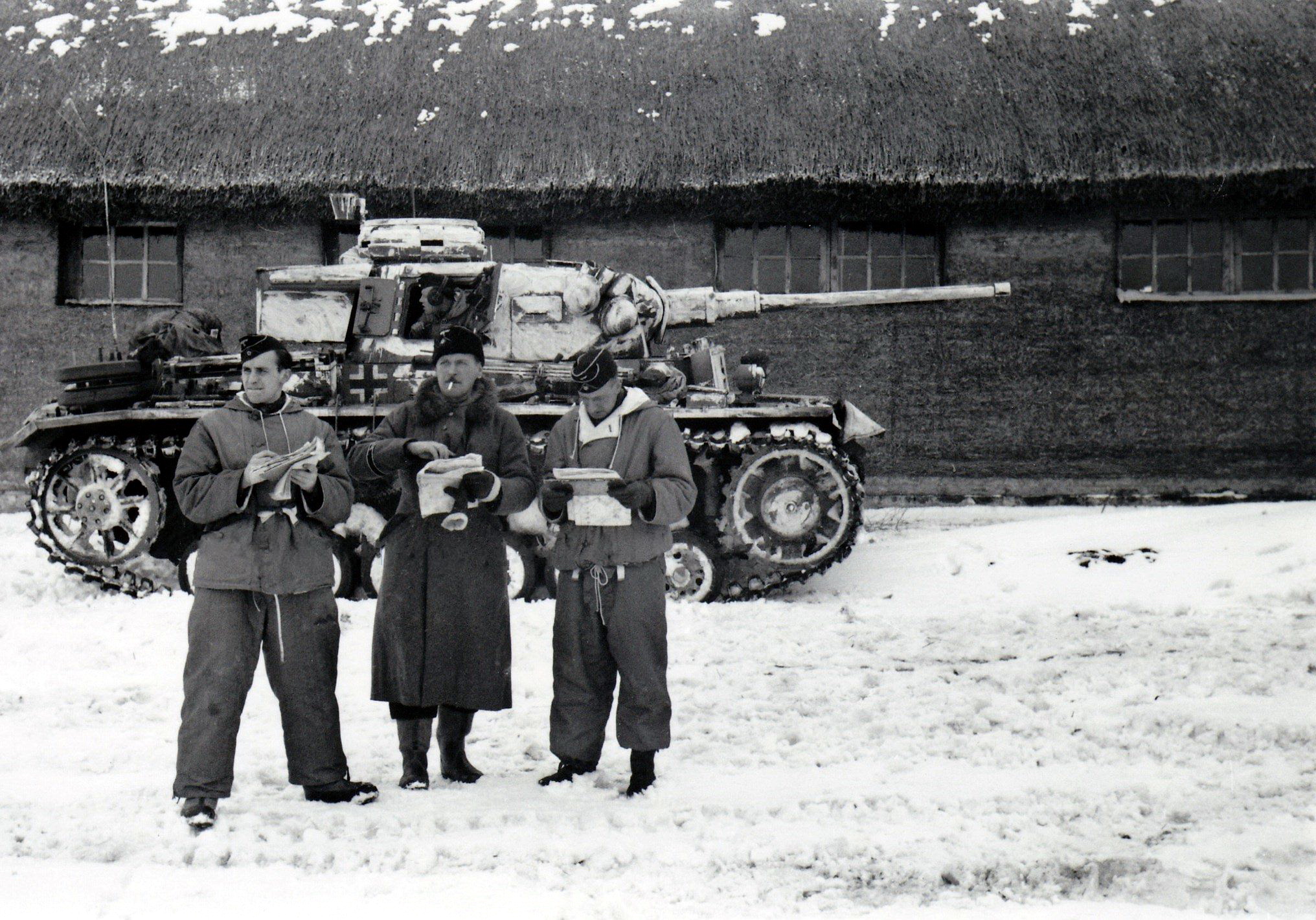
Kampfgruppe von Strachwitz (March-April 1944)


"Kampfgruppe von Strachwitz" - part of Heeresgruppe Nord - had different elements through March and April 1944. At that time, Strachwitz was also "Höherer Panzerführer bei der Heeresgruppe", and his task was keeping the few Panzers and Panzergrenadier companies together in counterattacks. In March 1944, Panzerverband Strachwitz was given to the 11. Infanterie-Division. In April 1944, it was given to the 61. Infanterie-Division and the 122. Infanterie-Division.

Panzergruppe Strachwitz contained ad-hoc units as follow:
V.Abteilung / Panzer-Regiment "Großdeutschland" (Tigers)
Panzer-Abteilung Feldherrnhalle (5 Panzer IV)
Füsilier-Bataillon. 61
Füsilier-Bataillon 122
III.Bataillon / Grenadier-Regiment 410
Pionier-Bataillon 122
2.Kompanie / schwere-Panzer-Abteilung 502
1.Kompanie / Pionier-Bataillon 652
1.Kompanie / Pionier-Bataillon 676

From KTB (Kriegstagebuch) XXXXIII. Armeekorps:
19.03.1944 10:45 p.m : Oberst Graf Strachwitz will be assigned to Gen.Kdo. [XXXXIII.A.K.] as adviser on tank and assault gun deployment for the upcoming attack.
02.04.1944 12:00 p.m : As part of the preparations for the attack, Gen.Kdo. [XXXXIII.A.K.] from III./Gren.Rgt.410, Pi.Btl.122, 2./s.Pz.Abt.502, V./Grossdeutschland and parts of the Pz.Gren.Div.Feldherrnhalle formed the "Panzerverband Oberst Graf Strachwitz".


Source :
ECPAD archive photo collection
KTB XXXXIII.A.K. NARA T314, roll 1017
https://www.feldgrau.net/forum/viewtopic.php?t=27053
https://forum.axishistory.com/viewtopic.php?t=104857
https://imagesdefense.gouv.fr/fr/

Tuesday, October 25, 2022

German Tanks Near Moscow


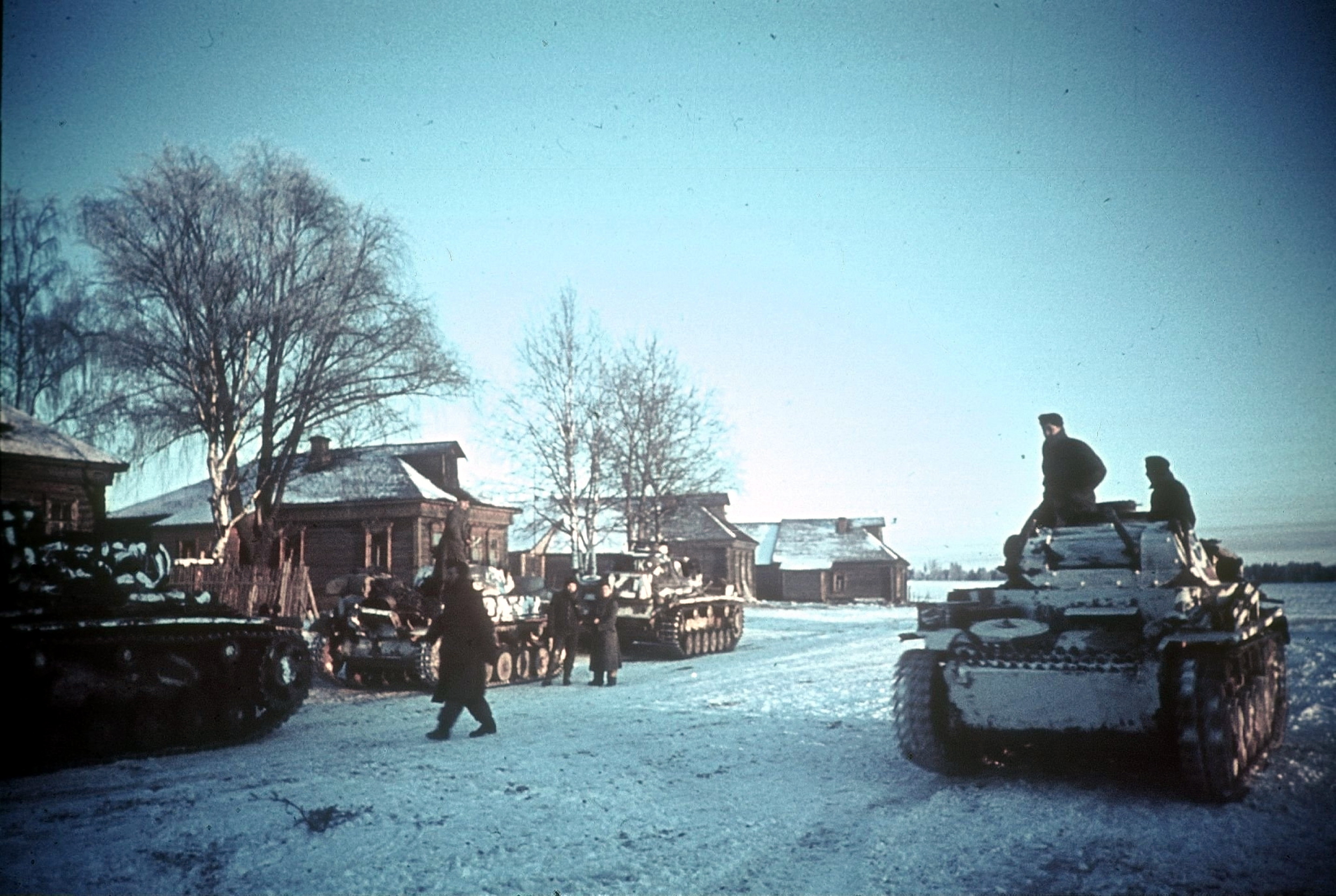
White winter camouflaged tanks of the 11. Panzer-Division in the village of Matronino near Volokolamsk. On the left, the first and third are Panzer III tanks, while between them and on the right is Panzer II tanks. The picture was taken by Kriegsberichter Artur Grimm in Moscow area, November 1941. From 31 October to 13–15 November 1941, the Wehrmacht high command stood down while preparing to launch a second offensive towards Moscow. Although Heeresgruppe Mitte (Army Group Centre) still possessed considerable nominal strength, its fighting capabilities had thoroughly diminished because of wear and fatigue. While the Germans were aware of the continuous influx of Soviet reinforcements from the east as well as the presence of large reserves, given the tremendous Soviet casualties, they did not expect the Soviets to be able to mount a determined defense.

Source :
https://en.topwar.ru/189069-tanki-shli-naprolom-podvigu-geroev-panfilovcev-80-let.html
https://en.wikipedia.org/wiki/Battle_of_Moscow

Wednesday, September 21, 2022

Guderian with a Panzer IV

Generaloberst Heinz Guderian (Oberbefehlshaber Panzergruppe 2) standing beside a Panzerkampfwagen IV of Panzer-Regiment 35 / 4.Panzer-Division, 12 September 1941. The picture was taken in the Eastern Front during Unternehmen Barbarossa, German invasion of Soviet Union.

Source :
https://www.ebay.de/itm/385120762924?hash=item59aafc7c2c:g:9FoAAOSwhjljJXfT

Sunday, January 10, 2021

Waffen-SS StuG Unit


There is no information about the unit of this Waffen-SS soldiers. It's either the 1. SS-Infanterie Brigade or the SS-Kavallerie Division, but in the winter of 1943/44 regardless. The photographer was named Ahrens, and there were several Waffen-SS war reporters with that name (both units had one of them). Both units also had a single battery of around 10 Sturmgeschützs.


Source :
https://www.facebook.com/photo/?fbid=10219232699879847&set=gm.751279962465553

Sunday, February 2, 2020

7. Panzer-Division in the Eastern Front

A Wehrmacht armored unit is seen resting on the sidelines of forward movement in Russia, in the summer of 1941. From the "Y" shaped markings written on the gepack-kasten (storage bin) on the back of the Panzer III on the left, we can find out that they are from the 7. Panzer-Division. This German medium tank is painted in dark gray (dunkelgrau), as well as Sd.Kfz.251 and other vehicles in the background, except the Kübelwagen car - which is likely to be used for reconnaissance missions - that painted in dark yellow ( dunkelgelb). This photo itself was taken from the air at low altitude by an unknown Kriegsberichter (war correspondent), possibly on a light transport aircraft Fieseler Fi 156 "Storch". During the Unternehmen Barbarossa (German invasion of Russia), 7. Panzer-Division operated in the middle sector of the Eastern Front, under the command of Generalleutnant Hans Freiherr von Funck who replaced the legendary previous commander, Erwin Rommel. The division started the campaign with 400 officers and 14,000 men.[32] By January 1942, six months from the start of the offensive, the division had suffered 2,055 killed, 5,737 wounded, with 313 missing and another 1,089 sick with frostbite and louse-borne diseases.


Source :
https://en.wikipedia.org/wiki/7th_Panzer_Division_(Wehrmacht)
https://wehrmachtss.blogspot.com/2020/02/7-panzer-division-di-front-timur.html

Saturday, January 25, 2020

Panzer IV Passes Combat Engineers

This Panzerkampfwagen IV Ausf.C passes a pair of pioniere troops (combat engineers) busily engaged in digging. The panzer is identified as an Ausf.C by the configuration of the view ports on the superstructure front. There is length of spare track fitted to the bow and an improvised jerry can rack on the fender. The turret has been retro-fitted with a storage bin, a very common occurrence.


Source :
Book "Panzer Vor: German Armor At War 1939-45" by Frank V. De Sisto

Sunday, November 17, 2019

Panzer 38(t) of 7. Panzer-Division in France 1940

The PzKpfw 38(t) Ausf B incorporated changes to better integrate the design into German practices, including German radios and tools. This is a column from I./PzRgt 25 (7. Panzer-Division) in France during June 1940. By the time of the 1940 campaign in Western Europe, over 200 PzKpfw 38(t) tanks had been delivered and Czech tanks amounted to about 13 per cent of German tank strength. Although a small fraction of overall German tank strength, they accounted for about half of the tanks armed with a 37mm gun. By 1940, two mechanized-cavalry divisions had been rebuilt as Panzer divisions with the PzKpfw 38(t) as their principal tank. 2. leichte Division became 7. Panzer-Division and 3. leichte Division became 8. Panzer-Division.


Source:
"Panzer 38(t) vs BT-7: Barbarossa 1941" by Steven J. Zaloga

Thursday, May 9, 2019

Panther '534' of Division Wiking in Poland

Having pushed to the row of farmhouses, Panzerkampfwagen V Panther '534' is now positioned to the right side of SS-Untersturmführer Gerhard Mahn's SPW (Schützenpanzerwagen). The tank commander transverse the turret as he looks for target. The 7.5 cm Kampfwagen Kanone 42/L70 could fire both high explosive and armored piercing ammunition; the amount of each type of shell carried was dependent upon the mission. In addition to the main gun, each Panther was armed with two MG-34 machine guns, with a total of 4,200 rounds of ammunition carried aboard the vehicle. The picture was taken by SS-Kriegsberichter Ernst Baumann at Nurzec-Stacja, northeastern Poland, on 22 July 1944.


Source :
Book "Kampfgruppe Mühlenkamp: 5. SS-Panzer-Division Wiking, Eastern Poland, July 1944" by Douglas E. Nash and Remy Spezzano 

Wiking Panther and Halftrack during Attack

Panzerkampfwagen V Panther '534' of SS-Panzer-Regiment 5 / 5.SS-Panzer-Division "Wiking" moves ahead into the farmyard. Contact is imminent, as shown by the tank commander taking cover inside his cupola. SS-Untersturmführer Gerhard Mahn (left, Chef 11.Kompanie / III.Bataillon / SS-Panzergrenadier-Regiment 9 "Germania" / 5.SS-Panzer-Division "Wiking") and his men continue to keep their heads down in case any Soviet infantry are encountered. Hanging inside the vehicle to the right of the Grenadier are three essential pieces of field equipment familiar to every German soldier: a Brotbeutel (bread bag), Essgeschirr (mess kit), and Feldflasche (canteen). The picture was taken by SS-Kriegsberichter Ernst Baumann at Nurzec-Stacja, northeastern Poland, on 22 July 1944.


Source :
Book "Kampfgruppe Mühlenkamp: 5. SS-Panzer-Division Wiking, Eastern Poland, July 1944" by Douglas E. Nash and Remy Spezzano 

Wednesday, December 26, 2018

Panzerbefehlswagen 38(t) tank of 12. Panzer-Division on the Eastern Front

Panzerbefehlswagen 38(t) tank of 12. Panzer-Division on the Eastern Front, 1941. German forces were equipped with a large number of type PzKpfw 38(t) – tchechoslowakisch – light tanks manufactured in Czechoslovakia, but were of limited fighting value, especially on the Eastern Front where German forces faces such a "beast" tanks like T-34 or KV1 and KV2 tanks.


Source :
Book "Panther" by Thomas Anderson

Thursday, November 29, 2018

Training of the German Scouts Force

It’s an old German military adage that Schweiß spart Blut (“sweat spares blood”), which means that a rigorous training program ensures that battle-inexperienced troops have a better chance of survival in their baptisms of fire. The German Army also practiced that adage, and its training programs were probably second-to-none in the prewar years. It was superior German training, coupled with flexible leadership and well-defined doctrine, that allowed the Germans to compensate for inferior numbers and occasionally inferior equipment. As the war lengthened and expanded in scope, the Germans were unable to sustain the rigorous training pace of the peacetime army. In addition, the continued attrition of the leadership ranks, particularly at the junior level, virtually assured a continuous decline in quality that also contributed in part to the inevitable downfall. Those factors also weighed heavily on the reconnaissance force, but because it and the other mechanized and armored forces shared a certain élan, they were called upon to be the backstop for the less mobile elements of the army and were often able to achieve far more than their mere numbers would indicate. The training for the force could be geared toward the individual soldier, the crew, the section, the platoon, and higher levels of command and also toward other service branches, but the end effect was directly related to the quality of the instruction and the instructors. The Germans insisted on after-action reports, thorough discussions of what transpired, and a debriefing of the entire unit or formation. In this image, a reconnaissance officer talks to some of his soldiers at the Bruck Training Area in modern-day eastern Austria in 1943.


Source :
Book "Scouts Out: A History of German Armored Reconnaissance Units in World War II" by Robert Edwards

Tuesday, November 27, 2018

A Befehlspanzer on the Russian Steppe

A Befehlspanzer (commander tank), based on Panzerkampfwagen III Ausf.J or L, sits next to a peasant's home on the open steppes of the Soviet Union. There are two rod antenna masts, one on either side of the panzer, as well as 20mm spaced armor on the mantle and the superstructure front plates. This panzer also seems to be mounting the longer L/60 version of the 5cm KwK39 main gun. The picture was taken at Kharkov region in 1943.


Source :
Book "Panzer Vor: German Armor At War 1939-45" by Frank V. De Sisto
https://id.pinterest.com/pin/288371182369236735/

Monday, June 20, 2016

Panzer IIIs in a Muddy Village Street

This Panzerkampfwagen III Ausf.E or F follows behind similar panzers through a mud-bound village street. There is a small tactical number (“201”) in white on a plate attached to the storage rack, and a white panzer rhomboid with a small “2”, designating this as a panzer of 2nd company’s command element. Note the configuration of the rear fender’s support for the flipped-up mud flap, and the Nazi flag on top of the stowage, used as an aerial recognition device.


Source :
Book "Panzer Vor: German Armor At War 1939-45" by Frank V. De Sisto

Saturday, May 14, 2016

A Column of Leibstandarte Vehicles Stuck in Mud

 A column of German Tiger I heavy tanks and a MAN ML 4500 truck of the 1. SS-Panzer-Division "Leibstandarte SS Adolf Hitler" become bogged down during the fight for Western Ukraine. Throughout October and November 1943, temperatures were hovering just above freezing, which meant sudden thaws and rain turned most roads and fields into thick, muddy quagmires that sucked in even tracked vehicles. Vinnytsia Oblast, Ukraine, Soviet Union. November 1943.


Source :
http://bag-of-dirt.tumblr.com/post/141221122000/a-column-of-german-tiger-i-heavy-tanks-and-a-man

Saturday, April 2, 2016

StuG III of 24. Panzer-Division

A Sturmgeschütz III Ausf.G driving to a training range in northern France, July/August 1943. The 24. Panzer-Division, to which this StuG III belongs, was re-equipped after the destruction at Stalingrad. From then on (until October 1944), the Panzer-Regiment 24 had only the III.Abteilung (3rd Battalion). The Sturmgeschützen were delivered to the 9. and 11. Kompanie (company). See "Sturmgeschütz III in Action", page 34. It shows another StuG III from the same unit at the same period.


Source :
Achtung Panzer magazine No.5 - Stug III, Stug IV and SIG.33

Monday, February 8, 2016

Tigers of Leibstandarte on a Mission West of Kiev

Tiger tanks from the 13.Kompanie / SS-Panzer-Regiment 1 of the Leibstandarte Division roll out on a mission west of Kiev in late 1943.


Source :
http://5sswiking.tumblr.com/post/115688410522/tiger-tanks-from-the-13ss-panzer-regiment-1-of

Tigers of Leibstandarte Advancing to the Front

Advancing to the front, the Tigers from the 13.Kompanie / SS-Panzer-Regiment 1 of the Leibstandarte Division in the area of operation west of Kiev in late 1943. 


Source :
http://5sswiking.tumblr.com/post/115862800892/advancing-to-the-front-the-tigers-from-the

Thursday, February 4, 2016

Panther of Panzer-Regiment 4 in Italy 1944

Panther ‘401’ from 4.Kompanie / I.Abteilung / Panzer-Regiment 4 / 13.Panzer-Division in northern Italy during late summer 1944.


Source :
http://5sswiking.tumblr.com/post/119969465087/panther-401-from-iabteilungpanzer-regiment-4

Monday, February 1, 2016

Counterattack of Wiking Division in Poland

Counterattack with Wiking Division Panzergrenadiere in Sd.Kfz. 251 and Panther ‘534’ from soldiers point of view, Nurzec-Stacja area, 22 July 1944. During this time 5. SS-Panzer-Division "Wiking" was engaged in counterattacks against Soviet armored and cavalry forces following their rapid advance during the Red Army’s Operation Bagration summer offensive. This photograph was taken by SS-Kriegsberichter Ernst Baumann and show Panther 534 moves ahead into the farmyard. Contact is imminent, as shown by the tank commander taking cover inside his cupola. SS-Untersturmführer Gerhard Mahn (Chef 11.Kompanie / SS-Panzergrenadier Regiment 9 "Germania") and his men continue to keep their heads down in case any Soviet infantry are encountered. Hanging inside the vehicle to the right of the Grenadier are three essential pieces of field equipment familiar to every German soldier: a Brotbeutel (bread bag), Essgeschirr (mess kit), and Feldflasche (canteen).


 Having pushed through the row of farmhouses, Panther 534 is now positioned to the right side of Mahn's SPW. The tank commander traverses the turret as he looks for targets. The 7.5cm Kampfwagen Kanone 42/L70 could fire both high explosive and armored piercing ammunition; The amount of each type of shell carried was dependent upon the mission. In addition to the main gun, each Panther was armed with two MG-34 machine guns, with a total of 4,200 rounds of ammunition carried aboard the vehicle.


Source :
Book "Kampfgruppe Mühlenkamp: 5. SS-Panzer-Division Wiking, Eastern Poland, July 1944" by Douglas E. Nash and Remy Spezzano