Showing posts with label Panzer I. Show all posts

Sunday, May 8, 2022

HQ of Panzer-Abteilung z.b.V. 40 in Denmark


Panzerkampfwagen I Ausf. Bs of 1.Kompanie / Panzer-Abteilung z.b.V. 40 at the entrance of the Jørgensens Hotel in Horsens, Denmark, which housed the headquarters of the battalion, April 1940. The hotel is located at Søndergade Street no. 17.

Panzer-Abteilung zur besonderen Verwendung 40 (Panzer-Abteilung z.b.V. 40), translating as "panzer unit for special purpose utilization", was formed on March 8, 1940 for the German invasion of Norway and of Denmark. The unit consisted mostly of Panzer I and Panzer II light tanks. It took part in the invasion of Denmark on 9 April and then was transported to Norway in April 1940.

The unit consisted of an HQ section and three companies, one taken from 3rd, 4th and 5th Panzer Divisions, each with three platoons as the fourth platoon remained with the original division in each case. On April 9, 1940 the unit complement included 69 tanks (42 Panzer I, 21 Panzer II and 6 Panzer I Befehlswagen command tanks.) Most of Panzer I tanks were Ausf A while the Panzer II tanks were primarily the Ausf c variant.

With the invasions on April 9, 1940, the First and Second companies were sent to Denmark while the Third company was sent to Norway aboard the transport ships Urundi and Antaris H.[1] On April 10, 1940 Antaris H was sunk by the Royal Navy submarine HMS Sunfish with the loss of 15 tanks and crew. Only two tanks, a Panzer I and II, arrived in Norway. German forces in Norway were reinforced by the First and Second companies, who embarked on 20 April and arrived on 24 April.


Source :
https://477768.livejournal.com/5996713.html
https://en.wikipedia.org/wiki/Panzer-Abteilung_40
https://www.reddit.com/r/wwiipics/comments/k5lpr8/panzer_i_ausf_bs_of_panzerabteilung_40_at_the/
https://waralbum.ru/357345/

Tuesday, May 3, 2022

Parade of Panzer-Abteilung z.b.V. 40 in Oslo

The German military parade of the Panzertruppen (Tank Troops) unit which were held at Karl Johans Gate, Oslo, the capital of Norway, on October 1, 1940. These Panzerkampfwagen I Ausf.B type tanks were from the Panzer-Abteilung z.b.V. 40 led by Oberstleutnant Ernst Volckheim (1898-1962), seen here giving a military salute accompanied by one of his officer. Volckheim is dressed in a black Panzer uniform. The Universitetsplassen square is surrounded by buildings of the University of Oslo.. Ernst Volckheim himself went down in history as one of the founders of the German panzer force, apart from the more famous Heinz Guderian. From 1924 he had written on the theory of tank warfare, drawing on his experiences in the First World War as a member of the Imperial German Tank Corps. Ironically, the one who then received wider publication was Guderian, who had just written his masterpiece, "Achtung Panzer!", only in 1937! This is because it was the latter who introduced the armored unit to German leader Adolf Hitler, who was then so impressed by Guderian's presentation that he immediately said enthusiastically, "This is what I need! This is what I want to have!"

The Norwegian "Aftenposten" newaspaper described the parade on page 2 in its evening issue on Tuesday 1 October 1940, as follows: "German armored vehicles parade on Karl Johan. Just before half past ten this morning, a large German military music corps marched down Karl Johan and lined up just opposite the University on the occasion of German armored vehicles parade for its commander, Colonel Volksheim. It was not long after the band had lined up, before people gathered along the curb to watch the parade. And on the University Stairs, a number of students had gathered, who had a short break between lectures. Before the parade itself, the units that were to participate were gathered on Tullinløkken and marched from there to their tanks, which were meanwhile parked in the side streets. Shortly after, the long wagon column came up in Karl Johan and passed over Drammensveien. When Colonel Volksheim had taken his place, the first tank passed the colonel a moment later, while the music played a military march. Armored car after armored car rolled past on its belts. Different types of passers-by, followed by open cars, which brought everything an armored battalion needs to be effective. When the last carriage in the column had passed, Colonel Volksheim drove away, the music was silent and the parade was over. A few minutes later, the traffic went back to normal on Karl Johan."


Source :
https://commons.wikimedia.org/wiki/File:Fo30141711070017_WW2_Norway_1940-10-01_Wehrmacht_Panzertruppen_Ernst_Volckheim_Panzerkampfwagen_German_Tank_troops_parade_salute_Karl_Johans_gate_Universitetsplassen_Oslo_NTBs_krigsarkiv_Riksarkivet_CC_BY_Rettighetshaver_etc_krediteres.jpg

Sunday, December 19, 2021

German Panzers in Poland 1939

Poland, on the Brda river.- Panzer soldiers on German Panzer Is and Panzer IIs, along with a medium Schützenpanzer half-track Sd.Kfz. 251/3. The officer in the halftrack vehicle might be Heinz Guderian. The picture was taken circa 3 September 1939 [Date of release?]. Germany declared war on Poland on Friday, September 1, 1939, and attacked with massed motorized columns of armor, infantry, artillery and waves of bombers and fighters in what was dubbed the Blitzkrieg (“Lightning War”). On Sunday, two days later, while German troops continued to pour into Poland, France and Britain declared war on Germany and proceeded to launch no major military land operations in what came to be known as the Sitzkrieg (“Sitting War"), a play on the word Blitzkrieg.

Source :
Bundesarchiv Bild 146-1976-071-36
https://commons.wikimedia.org/wiki/File:Bundesarchiv_Bild_146-1976-071-36,_Polen,_an_der_Brahe,_deutsche_Panzer.jpg
https://owlcation.com/humanities/Sitzkrieg

Wednesday, March 25, 2020

Chassis of Panzer I for Driver's Training

Chassis of a Panzer I used for driver’s training at the Zossen Training Area. Zossen Training Area placed great demands on the driving skills of students, who referred to the area as the “waves of the Danube.” During this period, the first chassis of what was to become the Panzer I arrived for driver’s training. As a deception measure, the vehicles were referred to as "agricultural tractors"!


Source:
"Panzers in the Sand: The History of Panzer-Regiment 5" by Bernd Hartmann

Thursday, March 31, 2016

A Column of German Armor Followed by Infantry

This pair of Panzerkampfwagen IIs (Ausf.A, B or C) leads a column of German armor along a road. They are followed by a Panzerkampfwagen I and Panzerkampfwagen III, and are accompanied by infantrymen who are moving along the shoulder of the road. Both Panzer IIs have the modifications introduced due to experience reports from the Polish and French campaigns. These include bolted-on armor on the turret fronts, superstructure fronts and a spaced-armor array covering the originally-rounded bow with angled plates. There was also a new circular commander's cupola with periscope vision blocks that replaced the original split-hatch design; note the head protection pad on the opened hatch lid. The armor addressed the problems encountered by enemy use of anti-tank rifles, while the cupola enhanced the vision of the commander when the panzer was buttoned-up. With the modifications shown, the panzer should also have been fitted with the Notek black-out driving system; in this case it has not . The markings, "6L..." (in yellow) do not conform to normal practice, but were used by the 4. Panzer-Division to designate "leichter" (light) tank companies. However, it appears that the divisional insignia on the superstructure front plate has been obscured. Note how the Balkenkreuz national insignia (with white outline) on the superstructure side, carries over to the radio antenna's protective storage trough.


Source :
Book "Panzer Vor: German Armor At War 1939-45" by Frank V. De Sisto

Wednesday, February 24, 2016

Polish Vehicles in German Inventory in 1939

A lot of Polish vehicles were either destroyed or abandoned after the end of Fall Weiss (German military campaign in Poland), like C7P artillery tractor and C2P tractor. Some Polish tanks were incorporated into German ranks like the 7TP. There's also some rarely found Brückenleger I and Panzer Is. 


 C7P artillery tractor


C2P tractor


7TP


Brückenleger I and Panzer Is


Source :
http://www.history.jp/wehrmacht/008.htm

Sunday, February 21, 2016

Panzer Is and IIs during Maintenance and Training in Winter

A group of Panzerkampfwagen Is and IIs, representing at least a company-sized detachment, receive maintenance amidst the snows of winter. There are no discernable markings on any of the panzers, while the condition of the Panzer IIs indicate that no retro-fitted armor is installed. The various crewmen visible wear the black M1934 panzer uniforms, some with M1935 greatcoats. Some men wear M1934 berets, while one hardy soul to the left is getting by with a pull-over sweater! The photo probably dates from the winter of 1938-1939.


In blizzard-like conditions, another Panzer-Kompanie is photographed during training. The snow covering the vehicles makes it impossible to determine which models they are, except that they are Panzerkampfwagen Is and IIs. Several crewmembers pose for the camera wearing the M1934 black panzer uniforms and berets.


Source :
Book "Panzer Vor: German Armor At War 1939-45" by Frank V. De Sisto

Children Receive Instructions from Panzermänner

An apparently fascinated group of children receive instructions on the running gear of a Kleine Panzerbefehlswagen from one of the crewmembers. The vehicle has added armor on the superstructure front; note how the visors and MG ball mount are flush with the surface. There is no bolted-on-armor plate on the superstructure side at the fender top and no Notek blackout head-lamp has been fitted (although the device was accepted for use in June of 1939). The balkenkreuz national insignia consists of a black center with a white outline, but it has been over-painted on the bottom. Both crewmen wear the black M1934 uniform; one wears an M1935 “Feldmütze” (field cap), while the other wears the black M1934 beret over a padded inner helmet. This combination of uniforms, vehicle finish and features, as well as the weather and terrain may place this photo in the early part of 1940, prior to the French Campaign.


Source :
Book "Panzer Vor: German Armor At War 1939-45" by Frank V. De Sisto

Instandsetzungskraftwagen of Panzergruppe Kleist

A column of Panzerkampfwagen III (Ausf.D, E or F) leads a Panzerkampfwagen I Ausf.B ohne Aufbau, which has been converted into a vehicle to carry maintenance equipment for the panzer company’s repair and recovery sections, by the removal of its superstructure and turret. It was also known as “Instandsetzungskraftwagen I”. Note the yellow gothic “I” (which appears to be a “J”) that identifies the vehicle’s function, on the rear corner of the engine deck, as well as the white “K” of Panzergruppe von Kleist. Note also the small square tactical markings on the rear turret face of the Panzer IIIs and the racks for jerry cans on their rear decks.


Source :
Book "Panzer Vor: German Armor At War 1939-45" by Frank V. De Sisto

Wednesday, February 17, 2016

12. Panzer-Division in Ssinjawino (Sinjavino) Heights


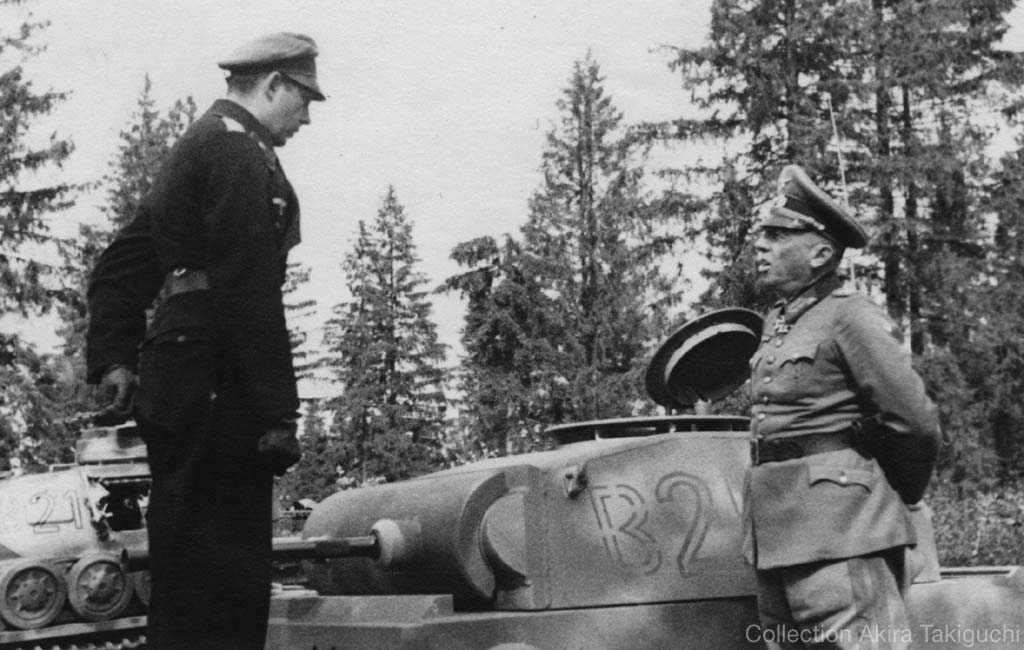
12. Panzer-Division incorporated remaining tanks from Panzer-Abteilung z.b.V.66 such as this VK 16.01. The picture also showing the commander with Generalfeldmarschall Georg von Küchler (Oberbefehlshaber Heeresgruppe Nord) in late 1942. The VersuchsKetten VK-1601 (experimental fully tracked vehicle 16 tons model 01) was a tank slightly based on the Panzer II. The object was to improve the armor and therefore the survivality in the battefield. In order to do so the frontal armor was 80 mm and 50 mm in the side hull /turret. This tank copied the crew layout in the Pz II , with an Tank commander/gunner/ loader, radio operator and driver. The development for an "ZERO" series was issued in December 1939, development of the chassis was entrusted ton MAN and the turret went to Daimler-Benz. The fisrt VK1601 was completed in June 1940.


Panzerkampfwagen I Ausf.F (VK 18.01) of 12. Panzer-Division in Sinjavino Heights, 1943.


 Panzerkampfwagen IV Ausf.G "B11" of 8.Kompanie / II.Abteilung / 12.Panzer-Division (ex 1.Kompanie / Panzer-Abteilung z.b.V.66) in Sinjavino Heights, 1943

Source :
http://www.history.jp/wehrmacht/008a.htm
http://panzerserra.blogspot.co.id/2012/10/panzer-ii-ausf-j-alan-135-part-01.html

Monday, February 8, 2016

Panzers of 7. Panzer-Division in the French Campaign

A Panzerkampfwagen I Ausf.B leads a column consisting of wheeled vehicles and Panzerkampfwagen 38(t)s during the French Campaign. From this angle the panzer is identified as an Ausf.B by the lack of a vehicle jack stowed on the right front fender (although some Ausf.Bs did, in fact, have a jack stowed in that position). A close look at the superstructure, next to the radio antenna, as well as the front plate will reveal an inverted "Y" with three dots, which was the divisional insignia of 7. Panzer-Division, which was equipped with the Pz.Kpfw.38(t).


Source :
Book "Panzer Vor: German Armor At War 1939-45" by Frank V. De Sisto

Sunday, February 7, 2016

Panzer I and IIs Passing an Anti-Tank Obstacles in the French Campaign

This Panzerkampfwagen I Ausf.A belongs to the 8.Kompanie of the Panzer-Regiment as denoted by the tactical number "842", which along with an outline-style balkenkreuz, is painted in white on the superstructure side. The panzer is laid-up next to steel anti-tank obstacles, probably in a French city during the 1940 campaign. Of note is the way in which the road-wheel hubs as well as the drive sprockets have collected a coating of mud and dust, while the tires have not. From this angle, it is identified as an Ausf.A by certain features of the suspension system such as: the way the track slopes downwards after the third return roller, as well as the girder and spring configuration. A pair of Panzer IIs in the background continue the onslaught.


Source:
Book "Panzer Vor: German Armor At War 1939-45" by Frank V. De Sisto

A Bogged-Down Panzer I Prepared for Extrication

A thoroughly bogged-down Panzer I Ausf.B stands idle while it is prepared for extrication. Note the man in the far background who is running a tow cable out to another vehicle. The panzer is devoid of markings and should be finished in the two-color scheme of dunkelgrau Nr.46 base with dunkelbraun Nr.45 oversprayed. It is recognizable as an Ausf.B by the longer engine compartment which housed a Maybach NL38TR gasoline engine, as well as the lack of exhaust mufflers on the rear of the fenders. Note the black panzer crew uniforms and the quite oversized appearance of the berets, which covered a paddled inner helmet.


Source :
Book "Panzer Vor: German Armor At War 1939-45" by Frank V. De Sisto

Tuesday, February 2, 2016

Panzer I Moves along a Forest Track during Polish Campaign

A panzer crewman looks on as a Panzerkampfwagen I Ausf.A moves along a sandy forest track during the Polish campaign, 11 September 1939. Note the thick white Balkenkreuz national insignia on the turret, characteristic of that campaign. The vehicle (which is a 2.Serie/La.S chassis as denoted by the view port on the rear face of the superstructure) has additional fittings, which were ordered to be attached at various times during the year 1937. They include a "Nebelkerzenabwerfvorrichtung" (smoke candle deployment rack) on the hull rear, as well as armored cowls over the engine air intakes and exhausts. Note also the single engine exhaust mufflers on the rear of both fenders and what appears to be a pennant on the antenna.


Source :
Book "Panzer Vor: German Armor At War 1939-45" by Frank V. De Sisto
https://audiovis.nac.gov.pl/obraz/167/h:476/