Showing posts with label Panzer Crew. Show all posts

Sunday, March 5, 2023

Panzer IV of 2. Panzer-Division during Training in the West 1940


Panzerkampfwagen IV Ausf.D with Crew of 5.Kompanie / II.Abteilung / 2.Panzer-Division during training in the West, 21 March 1940. In the Fall Gelb (German invasion of France and Low Countries), 2. Panzer-Division consisted of two panzer regiments (15 and 31), part of Panzer-Brigade 8. The picture was taken by Kriegsberichter Huschke of PK (Propaganda-Kompanie) 698.

Source :
https://commons.wikimedia.org/wiki/File:Bundesarchiv_Bild_101I-124-0216-11,_Im_Westen,_Panzer_IV.jpg
https://id.pinterest.com/pin/9077636727409850/

Monday, December 26, 2022

Panzer IVs Before Operation Barbarossa


Two German Panzer IVs moving towards the German-Soviet demarcation line on 21 June 1941, less than 24 hours away before the start of Unternehmen Barbarossa, German invasion of Russia. In the foreground road sign "Grenze 1 km". For the campaign against the Soviet Union, the Germans allotted almost 150 divisions containing a total of about three million men. Among those units were 19 panzer divisions, and in total the Barbarossa force had about 3,000 tanks, 7,000 artillery pieces, and 2,500 aircraft.

Source :
https://9gag.com/gag/ajgVB0Q
https://en.topwar.ru/188854-21-ijunja-stalin-dilemma-prinjatija-reshenija.html
https://en.wikipedia.org/wiki/Operation_Barbarossa

Tuesday, October 25, 2022

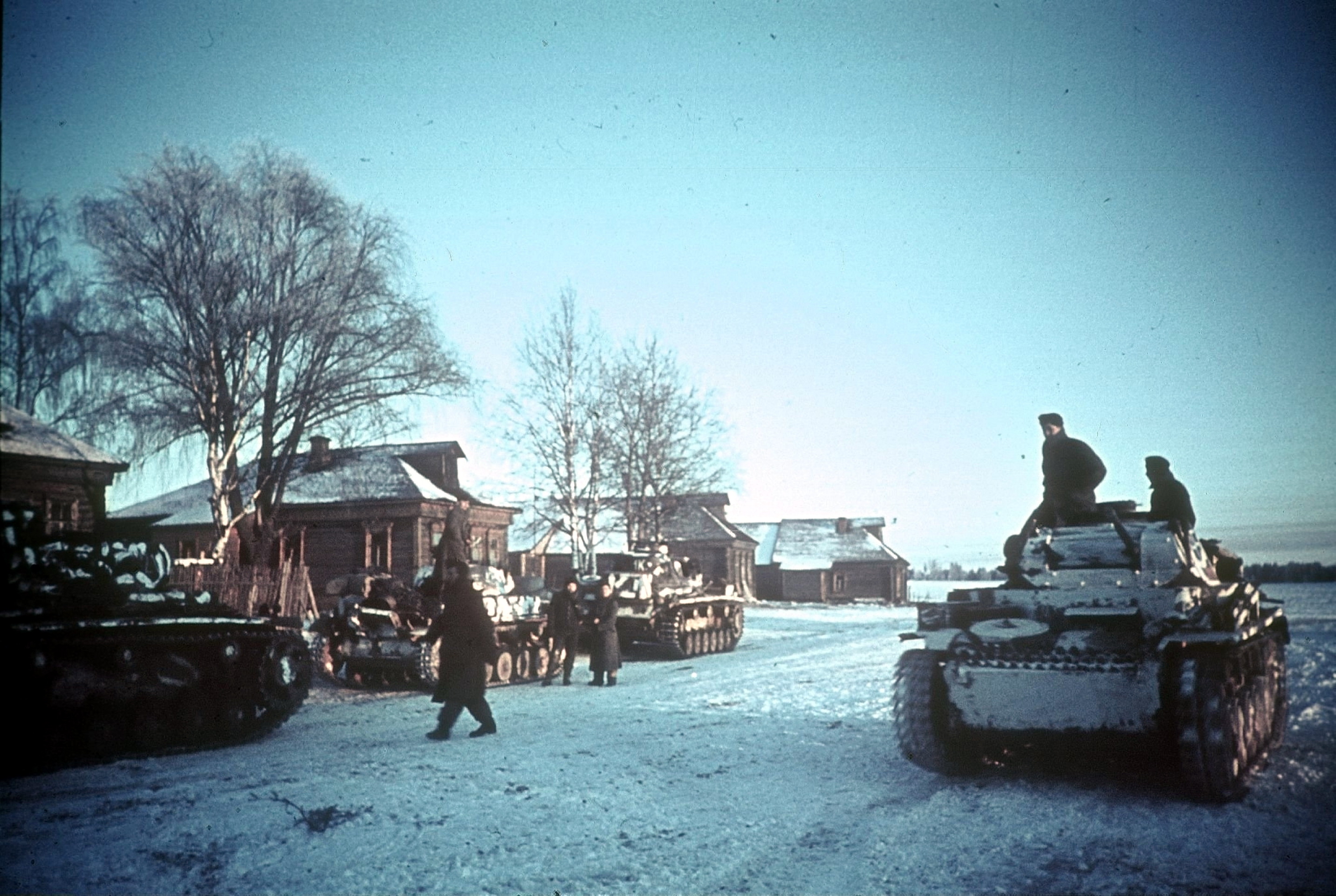
German Tanks Near Moscow


White winter camouflaged tanks of the 11. Panzer-Division in the village of Matronino near Volokolamsk. On the left, the first and third are Panzer III tanks, while between them and on the right is Panzer II tanks. The picture was taken by Kriegsberichter Artur Grimm in Moscow area, November 1941. From 31 October to 13–15 November 1941, the Wehrmacht high command stood down while preparing to launch a second offensive towards Moscow. Although Heeresgruppe Mitte (Army Group Centre) still possessed considerable nominal strength, its fighting capabilities had thoroughly diminished because of wear and fatigue. While the Germans were aware of the continuous influx of Soviet reinforcements from the east as well as the presence of large reserves, given the tremendous Soviet casualties, they did not expect the Soviets to be able to mount a determined defense.

Source :
https://en.topwar.ru/189069-tanki-shli-naprolom-podvigu-geroev-panfilovcev-80-let.html
https://en.wikipedia.org/wiki/Battle_of_Moscow

Sunday, October 23, 2022

Panzer IV Before Fall Gelb


Panzer IV Ausf.D in the Western Front before Fall Gelb, 21 March 1940. The picture was taken by Kriegsberichter Huschke from PK (Propaganda-Kompanie) 689. Despite increased production of the medium Panzer IIIs and IVs prior to the German invasion of France on 10 May 1940, the majority of German tanks were still light types. According to Heinz Guderian, the Wehrmacht invaded France with 523 Panzer Is, 955 Panzer IIs, 349 Panzer IIIs, 278 Panzer IVs, 106 Panzer 35(t)s and 228 Panzer 38(t)s. Through the use of tactical radios and superior tactics, the Germans were able to outmaneuver and defeat French and British armour. However, Panzer IVs armed with the KwK 37 L/24 75-millimetre (2.95 in) tank gun found it difficult to engage French tanks such as the Somua S35 and Char B1. The Somua S35 had a maximum armour thickness of 55 mm (2.2 in), while the KwK 37 L/24 could only penetrate 43 mm (1.7 in) at a range of 700 m (2,300 ft). The British Matilda II was also heavily armoured, with at least 70 mm (2.76 in) of steel on the front and turret and a minimum of 65 mm on the sides, but were few in number.

Source :
https://commons.wikimedia.org/wiki/File:Bundesarchiv_Bild_101I-124-0216-11,_Im_Westen,_Panzer_IV.jpg
https://en.wikipedia.org/wiki/Panzer_IV

Wednesday, September 21, 2022

Panzer III in Poland 1939

Poland.- Group of tanks standing in a meadow behind a village in Poland, September 1939. The tank in the foreground is a Panzer III Ausf. D with crews in turret. The picture was taken by Kriegsberichter Rascheit. Starting the Second World War since the invasion of Poland, Germany had only about a hundred Panzer III tanks, so in the Polish campaign and the battles with the French and British armies in the west, this tank was not so noticeable among the mass of more outdated tanks with which at that time it was armed tank forces Germany. But by the beginning of the eastern campaign of the Wehrmacht, the Pz.III had already become the main tank of the German army. On the Soviet borders on June 22, 1941, there were 965 Panzer III tanks!


Source :
Bundesarchiv Bild 101I-318-0083-30
https://commons.wikimedia.org/wiki/File:Bundesarchiv_Bild_101I-318-0083-30,_Polen,_Panzer_III_mit_Panzersoldaten.jpg
https://kvartiraidoma.ru/en/construction/pz-kpfw-3-modifikacii-f-n-rabochie-mesta-ekipazha-tanka-pz-iii-tank-pzkpfw.html

Thursday, September 23, 2021

Divisionskommandeur Rommel with Panzer 35(t) in France


Generalmajor Erwin Rommel with map and binoculars on foot on the way to the Scarpe section, while Panzer 35(t)s is waiting on the left. The picture was taken around the end of May or beginning of June 1940 at Nord-Pas-de-Calais, France.

Source :
Bundesarchiv Bild 146-1998-043-20A

Sunday, September 19, 2021

Panzer III with Eight Road Wheel in Poland

Group of tanks in a meadow. Panzer III Ausf. D with crew, tank soldier in the turret. The picture was taken in September 1939 during the German invasion of Poland. The photographer is Kriegsberichter Rascheit from KBK Lw 1 (Kriegsberichter-Kompanie Luftwaffe 1).

Starting the Second World War since the invasion of Poland, Germany had only about a hundred Panzer III tanks, so in the Polish campaign and the battles with the French and British armies in the west, this tank was not so noticeable among the mass of more outdated tanks with which at that time it was armed tank forces Germany. But by the beginning of the eastern campaign of the Wehrmacht, the Pz.III had already become the main tank of the German army. On the Soviet borders on June 22, 1941, there were 965 Panzer III tanks.


Source :
Bundesarchiv Bild 101I-318-0083-30 and Bild 101I-318-0083-32
https://kvartiraidoma.ru/en/construction/pz-kpfw-3-modifikacii-f-n-rabochie-mesta-ekipazha-tanka-pz-iii-tank-pzkpfw.html

Saturday, March 13, 2021

Panzer Ace Karl Brommann


Denis J. Horgan (the owner of the picture above): "Karl Brommann was another Panzer man who welcomed me into his home with my friend Peter Mooney. We spent a whole day with him and his wife. He joined the SS in 1937 and served in Totenkopf Standarte 2 and in 1939 joined the Totenkopf Artillery Regiment. In August 1940 he transferred to KG Nord and served in Finland in 1941 where he was seriously wounded. In May 1943 he transferred again , this time to the Nordland Division where he was in the Panzer Regiment. Brommann was wounded several times during the war and was holder of the wound badge in gold. While attached to SS Panzer Abteilung 503 he destroyed over 60 Soviet tanks between February and March 1945. On March 26 he destroyed six Josef Stalin tanks in one engagement. Later that day he was again injured and his war was over. He was removed to hospital and taken POW by the British on May 21, 1945. On April 29, 1945 he was awarded the Ritterkreuz for his actions. I have a collection of material which Karl gave me about the operation and actions of his unit 503, hopefully in the future when I have time I post up this material . The photos I am posting were given to me by Karl the day I met him with Peter."


Source :
Denis J. Horgan photo collection
https://www.facebook.com/photo/?fbid=162642689022793&set=gm.789533545306861