Showing posts with label 1943. Show all posts

Thursday, March 3, 2022

Two Regimentskommandeur of Grossdeutschland


Oberst der Reserve Hyazinth Graf Strachwitz von Gross-Zauche (left, Kommandeur Panzer-Regiment "Grossdeutschland") standing in front of his Panzerbefehlswagen's "three-ruble note" with number 0. To the right of Strachwitz is Oberstleutnant Karl Lorenz (Kommandeur Panzergrenadier-Regiment "Grossdeutschland"). This picture was taken in the summer of 1943 in the Eastern Front, during Unternehmen Zitadelle (Battle of Kursk). At the beginning of 1943, Panzer-Abteilung "Grossdeutschland" was upgraded into a tank regiment. At first, the commander's tanks carried two-digit tactical numbers: "01", "02", "03". And already in the summer of the same year, their numbering changed and in the Battle of Kursk the "befehl" of the regimental headquarters carried the numbers: "0", "01", "02". The same numbering, it seems, remained until the end of the war. At least for the summer of 1944, two command Panthers of the regiment headquarters with the numbers "0" and "01" are known. The battalion headquarters apparently had "classic" numbers with Roman numerals I and II.

Source :
http://tigerscorner.ru/gallery/index.php?option=com_content&view=article&id=89:2019-01-11-16-46-13&catid=34:2010-12-02-12-49-34&Itemid=53


Tuesday, July 20, 2021

Tiger Tanks Transported on Railway Carts

A group of Heavy Tiger I tanks being transported on railway carts to the front. The first tank has number '223' show this could be Schwere Panzer Abteilung 505. The photo is dated 2 November 1943. The original caption says: "In Gegenangriff geworfen. Bei den schweren abwehrkämpfen im Osten müssen oft in kürzester zeit umgruppierungen schweren waffen vergenomen werden. Hier werden Tiger panzer in einen gefährlichen frontabschnitt geworfen. Ihre durchschlagende kampfkraft wird auch hier keine entscheidende erfolge des eindes gestretten." (Thrown into counterattack. During the heavy defensive battles in the east, heavy weapons often have to be regrouped in a very short time. Here Tiger tanks are thrown into a dangerous section of the front. Your resounding combat strength will not save any decisive successes of the one here either)

Source :
https://www.ea-militaria.com/rare-tiger-1-press-photograph-1943.html

Saturday, March 13, 2021

Story of Marder III in North Africa


Rare Colour Picture of German Marder III (7.5cm PaK40.3 auf PzKpfw 38(t) Ausf H - Sd.Kfz. 138 Model) Tank Destroyers in Tunisia. Probably newly arrived and prepared to be sent to the front packed with gasoline drums and jerrycans. An unknown number of 7,5cm Pak40/3 auf Pz.38(t) Ausf.H (Sd.Kfz 138) did make it to Tunisia, and the only known units thus far to be known to have this vehicle was the 2.Kompanie / Panzerjäger-Abteilung 39 and the schwere Schwadron / Panzer-Aufklärungs-Abteilung 580. There is another image title "North Africa-unknown date. Vehicle captured in Tunis" on page 24 of the Zimmerit Press booklet by David V. Nielsen entitled 'Panzerkampfwagen 38(t)' which shows a 7,5cm Pak40/3 auf Pz.38(t) Ausf.H (Sd.Kfz 138). There appears that the DAK palm tree is located on the right side of the front plate and on the left there is a tactical symbol that looks like the front of an elephant's head. While the tactical marking, is for a Kavallerie Aufklärungs-Abteilung. It seems that units of the 90. leichte Afrika-Division carried some variations on the elephant theme of troop markings, (i.e. the 7,62cm FK auf SdKfz6, w/ H.Pz.Jg.Abt.605 etc.), so it is possibly belongs to the Panzer-Aufklärungs-Abteilung 580.BTW, an excellent reference on how the shade of RAL8000 looked like on the Hull and Wheels, RAL8020 on the Jerrycans, in addition to their fuel stowage!


After the failed Italian attack on the British positions in Egypt, Mussolini was desperate to convince Hitler to send military aid to his shattered forces in Africa.

Initially, Hitler was not interested in the Mediterranean. He reluctantly decided to help his ally and sent an armored force under the leadership of Erwin Rommel.

The Germans quickly found out that, beside the famous ‘88’ (88 mm Flak gun), the standard 3.7 cm and short 5 cm anti-tank weapons struggled against the well armored British Matilda tank.

A number of captured and modified 7.62 mm PaK 36(r) guns were also sent to the North African front. One great issue with this weapons was the low mobility on a front were speed was essential for success. Several solutions to this problem were tested, like the Sd.Kfz..6 armed with the 7.62 mm PaK 36(r) in a box shape casemate and the experimental half-tracks armed with the 7.5 cm L/41 gun.
Before sending the new Marder to Africa, it was necessary to adapt them for service in the African desert. In March 1942, one Marder III was equipped and tested with sand filters. The tests were successful and later vehicles sent to Africa would have these filters. The number of vehicles sent ranges from 66 to 117 (depending on the sources).

The first Marder IIIs (6 x Panzerjäger 38(t) für 7.62cm PaK36(r) - Sd.Kfz. 139] arrived to North Africa in May 1942, with the last one arriving in November 1942. The freshly arrived Marder IIIs were used to reinforce and equip anti-tank battalions of the 15th and 21th Panzer Divisions.

By late October 1942, the 15th Panzer Division had at its disposal some 16 Marder III [Panzerjäger 38(t) für 7.62cm PaK36(r) - Sd.Kfz. 139]. All were allocated to the 33rd Anti-Tank Battalion, together with a number of towed 5 cm PaK 38 anti-tank guns. After the British attack at El Alamein at the end of October 1942, the 33rd Anti-Tank Battalion was under a heavy attack. It managed to inflict some heavy damage to the British advance units but it also suffered losses. Almost all the Marder IIIs were lost, except one.

In September 1942, the 39th Anti-Tank Battalion of the 21st Panzer Division had around 17 PaK 38 guns and 18 Marder IIIs divided between two Kompanien (1st and the 2nd). There is little information on this unit’s participation in the Battle for Alam Halfa (October-September 1942). In late October 1942, during the British counterattack at El Alamein, all 18 Marder III vehicles were reported to be still operational. By the 25th of October, this unit was pulled out into reserve. The next day, the 2nd Kompanie was sent to the north to help stop a British attack while the 1st Kompanie was located to the south.

By the end of October, the 39th Anti-Tank Battalion was heavily involved in fighting, trying to free some encircled units of the 164th Light Division. On the 4th of November, the surviving German forces were forced to retreat. The 39th Anti-Tank Battalion lost all its Marder IIIs and had only a few 5 cm PaK’s left. By December, the 21st Panzer Division had only two Marders III, which were not even fit for action.

In March 1943, after some resting time, the 39th Anti-Tank Battalion was reformed and reinforced. The 1st Kompanie received 9 Marder IIIs [Panzerjäger 38(t) für 7.62cm PaK36(r) - Sd.Kfz. 139] and the 2nd Kompanie received Marder III Ausf.H [7.5 cm PaK 40/3 auf Panzerkampfwagen 38(t) Ausf. H, Sd.Kfz. 138]. They fought in Tunisia until the Axis surrender in May.

The 10th Panzer Division was pulled out from the Eastern Front and after some time resting was reinforced with 9 Marders III [with 7.5 cm PaK 40/3 auf Panzerkampfwagen 38(t) Ausf. H, Sd.Kfz. 138] in July 1942 (90th Anti-Tank Battalion).

The 10th Panzer Division was sent to the North African front in November 1942. In Africa, this unit was engaged in many battles against the British and newly-arrived American forces and the losses were heavy. The last Marder III was reported lost in March 1943.


Source :
https://ajhydell.com/2021/03/10/rare-color-pic-of-german-marder-iii-h-tank-destroyers-in-tunisia-probably-newly-arrived-and-prepared-to-be-sent-to-the-front-packed-with-gasoline-drums-and-jerrycans/?fbclid=IwAR1DnYJZVUEnlWeAG43yWDMNhd9obmWezHE6rtm_bfBqwyZzne5v2AHVWOY
https://www.facebook.com/groups/1728158044141689/permalink/2614494578841360/?__cft__[0]=AZVPCib9N6Y7F2MEOaWX0wsXncxZsf19rmZ8DqSgmylHY-qFh2eODVWIPH7Pa8kW4wdQjs1KECUh3riBlrcf3cPB4LELcO_15zbJdEBbTCt9IlNsheOvVHaYD00uSjJosbWLYRtK7OtkSo02rSpGQ7Rb&__tn__=%2CO%2CP-R
https://tanks-encyclopedia.com/ww2/germany/panzerjager-38t-fur-7-62-cm-pak-36r-sd-kfz-139-marder-iii/

Friday, February 8, 2019

Tiger of SS Totenkopf Arrived at Kharkov

A newly-arrived Tiger of SS-Panzergrenadier-Division "Totenkopf" required for the upcoming offensive at Kursk. This is the Tiger of SS-Untersturmführer Walter Köhler (Chef 9.Kompanie [schwere] / SS-Panzer-Regiment 3 "Totenkopf"). The photo is taken after its arrival in Budy southwest of Kharkov in May 1943. The tank still needs markings and camouflage paint; it would become Tiger Nr.911. Köhler himself was killed in action in Tiger 911 near Kljutschi at the south bank of the Psel River during the Battle of Kursk on July 12 1943.


Source :
http://stabswache-de-euros.blogspot.com/search?updated-max=2018-12-23T17:31:00%2B01:00&max-results=1

Sunday, February 3, 2019

Panzer IV of SS Panzer Regiment "Hitlerjugend"

An excellent close-up of a Panzerkampfwagen IV Ausf.H (turmnummer 615) from 6.Kompanie / II.Abteilung / SS-Panzer Regiment 12 / 12.SS-Panzer-Division "Hitlerjugend" with schürzen (side skirt) and zimmerit (anti-magnetic mine paste), on exercises under the supervision of army officers in Belgium in the end of 1943. Several vehicles from 6./SS-PzRgt. 12 feature the names of the crew's sweethearts painted on the tanks: here we have 'Wilma' painted on the commander's Cupola and 'Paula' painted on the driver's visor (along with a heart?). The commander and loader are wearing Kriegsmarine U-Boat leather jackets, which were an item particular to the Hitlerjugend and LSSAH Divisions. These uniforms were initially given to the Italian Navy, but were reclaimed by the LSSAH when they went to Italy to disarm part of the Italian Army in 1943. Alongside these leather uniforms were found large stocks of Italian camouflage material, which were soon made into clothing for the two divisions. Note, the radio operator appears to be wearing a feldgrau M40 side cap rather than the standard black Panzer cap (as worn by the loader). The commander wears an M43 camouflage field cap affixed with a non-regulation metal totenkopf. The picture was taken by Kriegsberichter Kurth from PK (Propaganda-Kompanie) 698.


Source :
https://commons.wikimedia.org/wiki/File:Bundesarchiv_Bild_101I-297-1722-27,_Im_Westen,_Panzer_IV.jpg
http://ww2incolour.blogspot.com/2011/07/panzer-iv-of-hitlerjugend-division.html

Tuesday, November 27, 2018

A Befehlspanzer on the Russian Steppe

A Befehlspanzer (commander tank), based on Panzerkampfwagen III Ausf.J or L, sits next to a peasant's home on the open steppes of the Soviet Union. There are two rod antenna masts, one on either side of the panzer, as well as 20mm spaced armor on the mantle and the superstructure front plates. This panzer also seems to be mounting the longer L/60 version of the 5cm KwK39 main gun. The picture was taken at Kharkov region in 1943.


Source :
Book "Panzer Vor: German Armor At War 1939-45" by Frank V. De Sisto
https://id.pinterest.com/pin/288371182369236735/

Sunday, October 30, 2016

Himmler Inspecting Tiger of Das Reich

Reichsführer-SS Heinrich Himmler examines a Tiger tank with SS-Hauptsturmführer Herbert Zimmermann (left), the commander of the 8.(schwere)Kompanie / SS-Panzer-Regiment 2 / SS-Panzergrenadier-Division "Das Reich", Kharkov area, Ukraine, 24 April 1943. In the hands of the Waffen-SS the Tiger will rule.


Source :
http://5sswiking.tumblr.com/post/152264370557/reichsf%C3%BChrer-ss-heinrich-himmler-examines-a-tiger

Saturday, May 14, 2016

A Column of Leibstandarte Vehicles Stuck in Mud

 A column of German Tiger I heavy tanks and a MAN ML 4500 truck of the 1. SS-Panzer-Division "Leibstandarte SS Adolf Hitler" become bogged down during the fight for Western Ukraine. Throughout October and November 1943, temperatures were hovering just above freezing, which meant sudden thaws and rain turned most roads and fields into thick, muddy quagmires that sucked in even tracked vehicles. Vinnytsia Oblast, Ukraine, Soviet Union. November 1943.


Source :
http://bag-of-dirt.tumblr.com/post/141221122000/a-column-of-german-tiger-i-heavy-tanks-and-a-man

Saturday, April 2, 2016

StuG III of 24. Panzer-Division

A Sturmgeschütz III Ausf.G driving to a training range in northern France, July/August 1943. The 24. Panzer-Division, to which this StuG III belongs, was re-equipped after the destruction at Stalingrad. From then on (until October 1944), the Panzer-Regiment 24 had only the III.Abteilung (3rd Battalion). The Sturmgeschützen were delivered to the 9. and 11. Kompanie (company). See "Sturmgeschütz III in Action", page 34. It shows another StuG III from the same unit at the same period.


Source :
Achtung Panzer magazine No.5 - Stug III, Stug IV and SIG.33

Saturday, March 12, 2016

SS-Sturmmann Henk Kistemaker

SS-Sturmmann Henk Kistemaker photographed in ealy 1943 during his recovery. Kistemaker, born on 4 October 1922 in the Netherlands, was an infantryman in the ‘Germania’ Regiment of the Wiking Division and later a member of a Panther Tank crew in the SS-Panzer Regiment 5 of the division. Wounded three times and awarded numerous decorations for valor, Kistemaker survived the war and wrote his war memoirs, 'Wiking - Een Nederlandse SS-er aan het Oostfront'.


Source :
http://5sswiking.tumblr.com/post/140053963267/5sswiking-ss-sturmmann-henk-kistemaker

Wednesday, February 17, 2016

12. Panzer-Division in Ssinjawino (Sinjavino) Heights


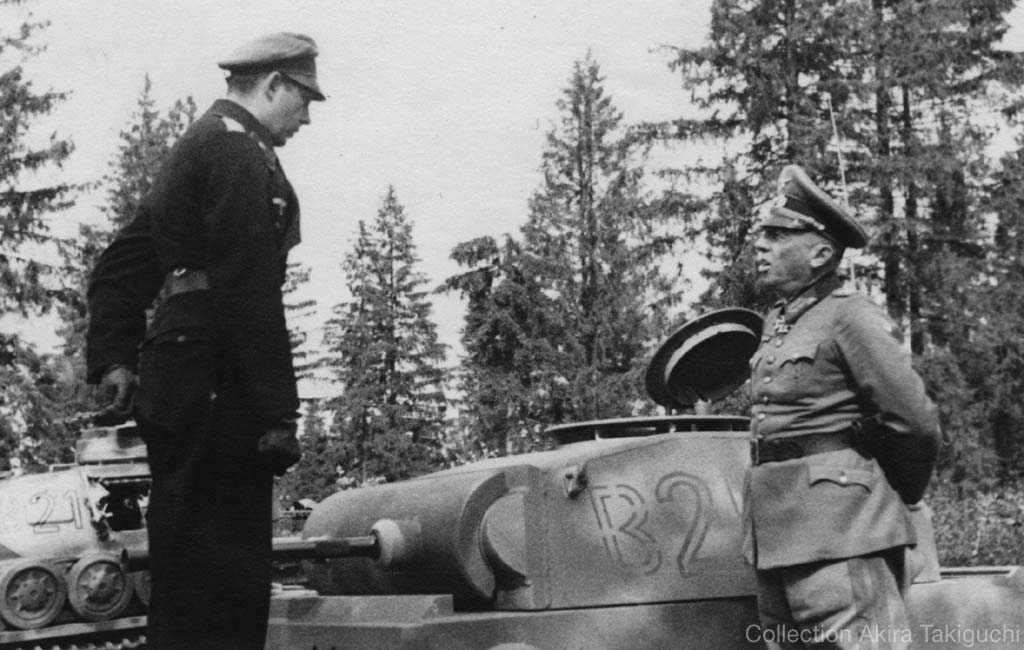
12. Panzer-Division incorporated remaining tanks from Panzer-Abteilung z.b.V.66 such as this VK 16.01. The picture also showing the commander with Generalfeldmarschall Georg von Küchler (Oberbefehlshaber Heeresgruppe Nord) in late 1942. The VersuchsKetten VK-1601 (experimental fully tracked vehicle 16 tons model 01) was a tank slightly based on the Panzer II. The object was to improve the armor and therefore the survivality in the battefield. In order to do so the frontal armor was 80 mm and 50 mm in the side hull /turret. This tank copied the crew layout in the Pz II , with an Tank commander/gunner/ loader, radio operator and driver. The development for an "ZERO" series was issued in December 1939, development of the chassis was entrusted ton MAN and the turret went to Daimler-Benz. The fisrt VK1601 was completed in June 1940.


Panzerkampfwagen I Ausf.F (VK 18.01) of 12. Panzer-Division in Sinjavino Heights, 1943.


 Panzerkampfwagen IV Ausf.G "B11" of 8.Kompanie / II.Abteilung / 12.Panzer-Division (ex 1.Kompanie / Panzer-Abteilung z.b.V.66) in Sinjavino Heights, 1943

Source :
http://www.history.jp/wehrmacht/008a.htm
http://panzerserra.blogspot.co.id/2012/10/panzer-ii-ausf-j-alan-135-part-01.html

Monday, February 8, 2016

Tiger S24 of Leibstandarte in the Eastern Front

Tiger ‘S24’ from the 13.Kompanie / SS-Panzer-Regiment 1 of the Leibstandarte Division in late December 1943 during one of the company’s numerous road marches from one crisis area to another. 


Source :
http://5sswiking.tumblr.com/post/111115220142/tiger-s24-from-the-13ss-panzer-regiment-1-of

Tigers of Leibstandarte on a Mission West of Kiev

Tiger tanks from the 13.Kompanie / SS-Panzer-Regiment 1 of the Leibstandarte Division roll out on a mission west of Kiev in late 1943.


Source :
http://5sswiking.tumblr.com/post/115688410522/tiger-tanks-from-the-13ss-panzer-regiment-1-of

Tigers of Leibstandarte Advancing to the Front

Advancing to the front, the Tigers from the 13.Kompanie / SS-Panzer-Regiment 1 of the Leibstandarte Division in the area of operation west of Kiev in late 1943. 


Source :
http://5sswiking.tumblr.com/post/115862800892/advancing-to-the-front-the-tigers-from-the

Wednesday, February 3, 2016

Tiger Commander Gives a Hand and Arm Signal

The commander of a Tiger from schwere Panzer-Abteilung 503 gives a hand and arm signal to tank commanders for them to initiate radio checks in August 1943, Kharkov region.


Source :
http://5sswiking.tumblr.com/post/122031032052/the-commander-of-a-tiger-from-schwere

Tigers of sPz.Abt.503 in Kharkov

The Tigers from schwere Panzer-Abteilung 503 in Kharkov region in the summer of 1943.


Source :
http://5sswiking.tumblr.com/post/122031596487/the-tigers-from-schwere-panzer-abteilung-503-in

Tiger of Panzer-Ersatz-Abteilung 500 in a Night March

A Tiger from Panzer-Ersatz-Abteilung 500 (training and replacement unit) based at Paderborn rolling on a street in 1943. It runs on liquefied coal gas and has four gas bottles mounted on the engine deck.


Source :
http://5sswiking.tumblr.com/post/122195346517/a-tiger-from-panzer-ersatz-abteilung-500-training

Tuesday, February 2, 2016

SS-Obersturmführer Horst Gresiak Photographed in 1943

SS-Obersturmführer Horst Gresiak photographed in 1943, was a tank commander in Das Reich Division when the division was reorganized as a Panzergrenadier Division during the latter part of 1942. Later in the war, he won the Ritterkreuz des Eisernen Kreuzes (Knight’s Cross of the Iron Crosses) in 25 January 1945 as a Führer of 7.Kompanie / SS-Panzer-Regiment 2 "Das Reich" during the Ardennes Offensive.


Source :
http://5sswiking.tumblr.com/post/123313590422/ss-obersturmf%C3%BChrer-horst-gresiak-photographed-in

Das Reich Award Ceremony after the Battle of Kharkov

First 5 from left: SS-Sturmbannführer Christian Tychsen, SS-Untersturmführer Karl Worthmann, SS-Sturmbannführer Sylvester Stadler, SS-Sturmbannführer Vinzenz Kaiser, SS-Sturmbannführer Hans Weiß

SS-Sturmbannführer Vinzenz Kaiser

SS-Sturmbannführer Vinzenz Kaiser and SS-Sturmbannführer Hans Weiß

Foreground (left-right): Unknown and SS-Sturmbannführer Christian Tychsen. Background (left-right): SS-Sturmbannführer Vinzenz Kaiser and SS-Sturmbannführer Hans Weiß

Background (left-right): SS-Sturmbannführer Vinzenz Kaiser, SS-Sturmbannführer Hans Weiß and SS-Obersturmbannführer Otto Kumm
SS-Gruppenführer Walter Krüger, the commander of the SS-Panzergrenadier-Division "Das Reich", has just given Knight’s Crosses and other awards to officers from his division for the superb conduct during successful counterattack at Kharkov, April 1943.


Source :
http://5sswiking.tumblr.com/post/123412768797/ss-gruppenf%C3%BChrer-walter-kr%C3%BCger-the-commander-of

Totenkopf Division Moments Before Attack


Moments before attack. The armoured fighting vehicles of SS-Panzergrenadier-Division "Totenkopf" carrying Panzergrenadiere in the run-up to a combined-arms attack during Operation Zitadelle in July 1943.


Source :
http://5sswiking.tumblr.com/post/123499615217/moments-before-attack-the-armoured-fighting