Showing posts with label Front Eastern. Show all posts

Sunday, April 2, 2023

Wiking Panzergrenadiers in Kovel

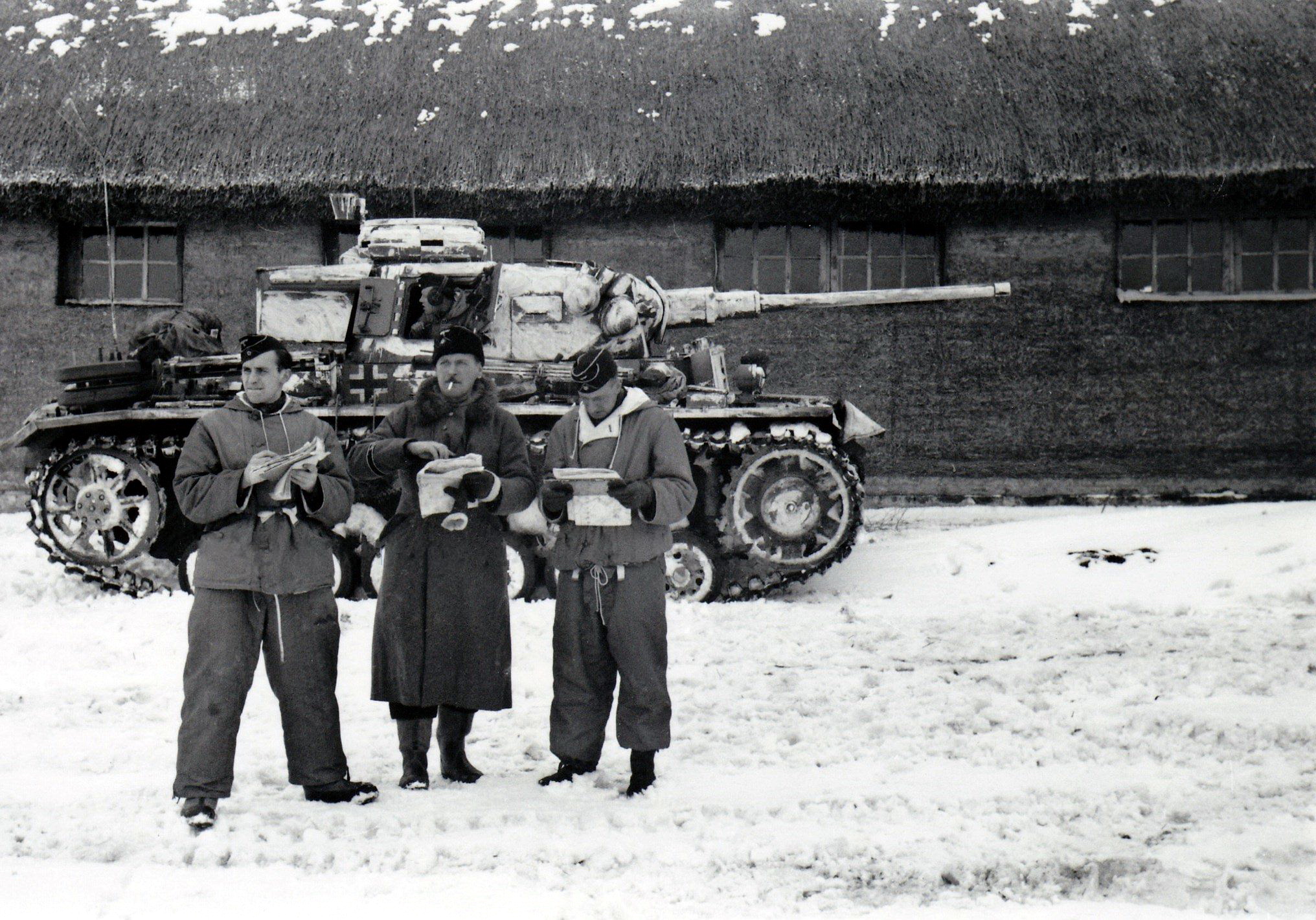
Heroic battle for Kovel: German medium tanks entered a village held by the Bolsheviks and knocked out the Soviets. now the SS-Panzergrenadiers of the 5. SS-Panzer--Division "Wiking" push up to break the Bolshevik encirclement. The picture was taken in the early spring 1944.


Source :
https://beeldbankwo2.nl/nl/beelden/?q=panzer&mode=gallery&view=horizontal

Sunday, March 19, 2023

Kampfgruppe von Strachwitz (March-April 1944)


"Kampfgruppe von Strachwitz" - part of Heeresgruppe Nord - had different elements through March and April 1944. At that time, Strachwitz was also "Höherer Panzerführer bei der Heeresgruppe", and his task was keeping the few Panzers and Panzergrenadier companies together in counterattacks. In March 1944, Panzerverband Strachwitz was given to the 11. Infanterie-Division. In April 1944, it was given to the 61. Infanterie-Division and the 122. Infanterie-Division.

Panzergruppe Strachwitz contained ad-hoc units as follow:
V.Abteilung / Panzer-Regiment "Großdeutschland" (Tigers)
Panzer-Abteilung Feldherrnhalle (5 Panzer IV)
Füsilier-Bataillon. 61
Füsilier-Bataillon 122
III.Bataillon / Grenadier-Regiment 410
Pionier-Bataillon 122
2.Kompanie / schwere-Panzer-Abteilung 502
1.Kompanie / Pionier-Bataillon 652
1.Kompanie / Pionier-Bataillon 676

From KTB (Kriegstagebuch) XXXXIII. Armeekorps:
19.03.1944 10:45 p.m : Oberst Graf Strachwitz will be assigned to Gen.Kdo. [XXXXIII.A.K.] as adviser on tank and assault gun deployment for the upcoming attack.
02.04.1944 12:00 p.m : As part of the preparations for the attack, Gen.Kdo. [XXXXIII.A.K.] from III./Gren.Rgt.410, Pi.Btl.122, 2./s.Pz.Abt.502, V./Grossdeutschland and parts of the Pz.Gren.Div.Feldherrnhalle formed the "Panzerverband Oberst Graf Strachwitz".


Source :
ECPAD archive photo collection
KTB XXXXIII.A.K. NARA T314, roll 1017
https://www.feldgrau.net/forum/viewtopic.php?t=27053
https://forum.axishistory.com/viewtopic.php?t=104857
https://imagesdefense.gouv.fr/fr/

Monday, December 26, 2022

Panzer IVs Before Operation Barbarossa


Two German Panzer IVs moving towards the German-Soviet demarcation line on 21 June 1941, less than 24 hours away before the start of Unternehmen Barbarossa, German invasion of Russia. In the foreground road sign "Grenze 1 km". For the campaign against the Soviet Union, the Germans allotted almost 150 divisions containing a total of about three million men. Among those units were 19 panzer divisions, and in total the Barbarossa force had about 3,000 tanks, 7,000 artillery pieces, and 2,500 aircraft.

Source :
https://9gag.com/gag/ajgVB0Q
https://en.topwar.ru/188854-21-ijunja-stalin-dilemma-prinjatija-reshenija.html
https://en.wikipedia.org/wiki/Operation_Barbarossa

Tuesday, October 25, 2022

German Tanks Near Moscow


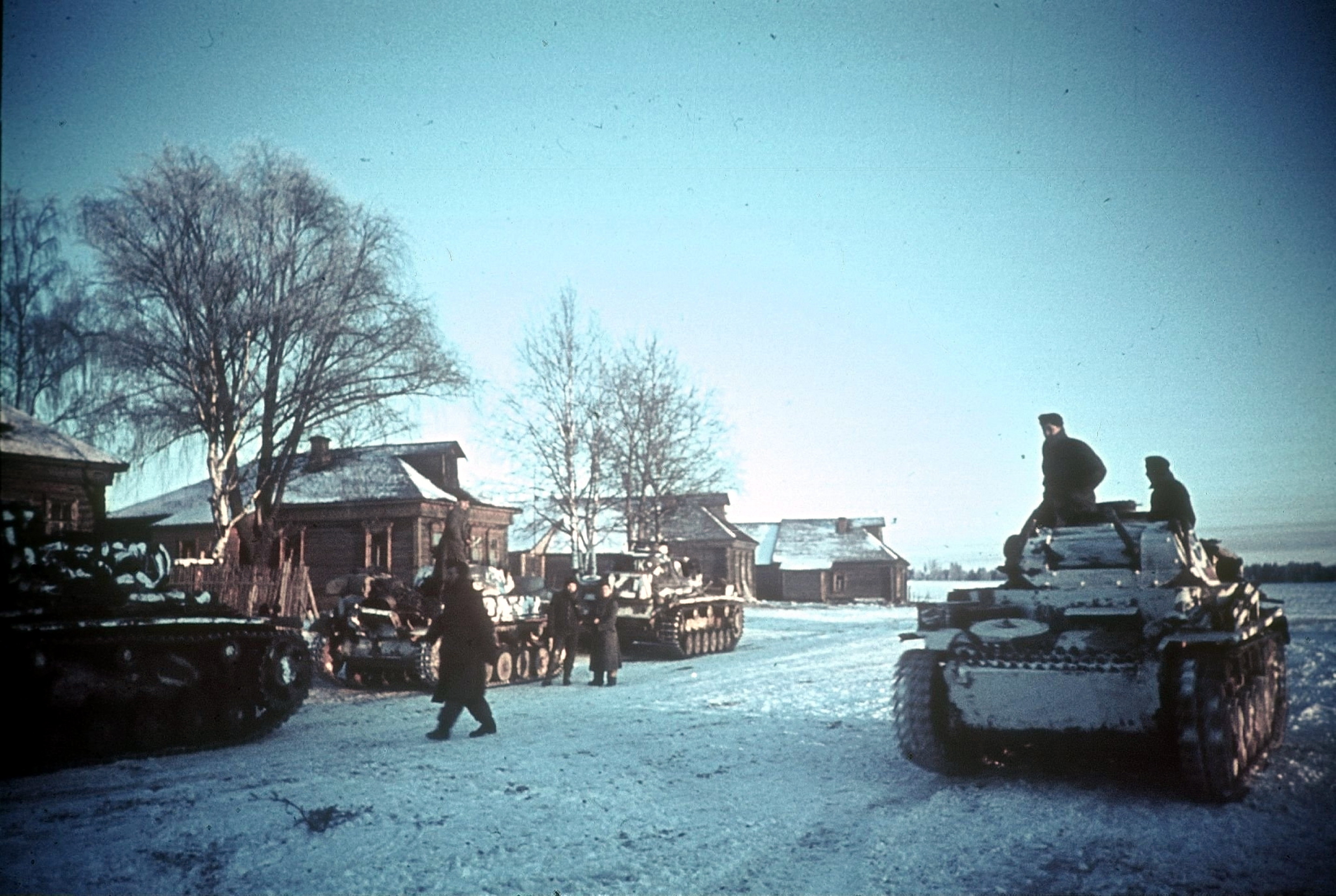
White winter camouflaged tanks of the 11. Panzer-Division in the village of Matronino near Volokolamsk. On the left, the first and third are Panzer III tanks, while between them and on the right is Panzer II tanks. The picture was taken by Kriegsberichter Artur Grimm in Moscow area, November 1941. From 31 October to 13–15 November 1941, the Wehrmacht high command stood down while preparing to launch a second offensive towards Moscow. Although Heeresgruppe Mitte (Army Group Centre) still possessed considerable nominal strength, its fighting capabilities had thoroughly diminished because of wear and fatigue. While the Germans were aware of the continuous influx of Soviet reinforcements from the east as well as the presence of large reserves, given the tremendous Soviet casualties, they did not expect the Soviets to be able to mount a determined defense.

Source :
https://en.topwar.ru/189069-tanki-shli-naprolom-podvigu-geroev-panfilovcev-80-let.html
https://en.wikipedia.org/wiki/Battle_of_Moscow

Tuesday, October 11, 2022

German Tanks in the Night


The German tanks fighting against Soviet tanks. A rocket flare in the night. Undated photograph, taken by photographer Artur Grimm and published by 'Signal' 19/1942.

Source :
'Signal' magazine 19/1942

Sunday, October 9, 2022

German Panzer Strength in the Operation Barbarossa


German Panzer III tank on the advance in the Ukraine during Operation Barbarossa, summer 1941. Photographer: Artur Grimm.

There are some that believe the sheer numerical superiority of the Red Army and Allies doomed Germany to defeat less than two years after continent wide war resumed in Europe late in 1939. For instance, the vast majority of David Stahel's decade long work posits that the Wehrmacht in general, but the German army (Heer) in particular, had shot their bolt as early as August of 1941. In assessing such claims this article will take a look at the primary component of the German army's striking power - it's panzer divisions. More to the point, I shall examine the state of the tank complement in those panzer divisions assigned to Operation Barbarossa (the June 1941 German invasion of the Soviet Union) after the campaign's first three months. In doing so, I hope to highlight one of many elements (for instance manpower losses in the infantry divisions would be another) that taken together can help readers understand for themselves whether or not the Ostheer (German army in the east) was beyond repair early in the fall of 1941.

The panzer divisions ready to invade the Soviet Union late in June 1941 were at that time the most powerful combined arms organizations in the world. For that matter, the quality of the armor fleshing out those panzer divisions had taken a quantum leap over that of the previous year. Whereas more than half the panzers deployed in France during May of 1940 were light Panzer I and II variants, by June of 1941 fully two thirds of each division's panzer complement comprised the far more capable Pz 35/38t, Panzer III/IV, and StuG (assault guns). Most importantly, the Panzer III, arguably the main battle tank (MBT) of the German army in 1941, had been significantly improved. On the eve of Barbarossa the Panzer III Ausf G to J series served as the majority of medium tanks in Germany's inventory (1,090 of 1,440 Panzer III).These upgraded Panzer III's featured 30mm thicker frontal armor than their predecessors, offering for greater protection. In terms of hitting power the 50mm L/42 cannon represented a huge improvement over the old 37mm gun. From there, the 50mm L/60 main gun equipping the J model Panzer III's (see picture accompanying this article) that went into production in April 1941 had twice the muzzle velocity and thus penetrating power of even the L/42 gun.

In addition, each panzer division gained a motorized infantry regiment. This had increased the division's ability to operate in built up urban areas, guard it's flanks, sweep up bypassed centers of resistance, hold terrain, and ward off counterattacks. Off-road mobility also had improved as the number of half-tracks increased as did firepower further supplemented by the addition of assault guns and anti-aircraft battalions to the panzer divisions. Moreover, previous TO&E calling for two light artillery battalions had been upgraded so that each panzer division also deployed a heavy artillery battalion including a dozen 100mm cannons and 150mm howitzers. As such, the June 1941 era panzer divisions represented a far better balance of infantry, armor, artillery, supporting arms,and thus combined arms strength than did the Polish/French campaign vintage panzer divisions.

In terms of the number of tanks available, by June of 1941, and even with Rommel's Afrika Corps taking 314 panzers, the German army still held a surplus of 974 panzers and assault guns (including 490 Pz 35/38t, Panzer III/IV, and StuG) - and this doesn't include the 312 armored fighting vehicles produced by German factories in that same month. All told, the German army had 6,052 tanks in June 1941 (including those in repair and being upgraded). It's important to note here that sources vary in regards to the actual numbers of panzers/assault guns in the nineteen panzer divisions initially participating in Barbarossa. But, if one excludes those tanks assigned to the forces fighting in the Arctic Circle and includes the StuG assault guns assigned to the eleven assault gun battalions deployed for Barbarossa as well as those weapons given to the Waffen-SS motorized divisions and Motorized Infantry Regiment Grossdeutschland; and if one then goes with the most reputable estimates published we end up with over 3,500 panzer/assault guns deployed in Eastern Europe. This number can be further broken down as follows: 337 Panzer I, 890 Panzer II, 155 Panzer 35(t), 625 Panzer 38(t), 973 Panzer III, 439 Panzer IV, 225 Beflpz., 259 StuG. So that's what the Germans were starting with when they invaded the Soviet Union. Now, let's fast forward and look at that state of the panzer division's tank strength in each of the three German Army Groups (North, Center, South) following the brutal fighting that characterized Barbarossa's first three months. If Stahel's thesis is correct then by late in August/early September 1941 these divisions should have become mere shells of their former selves.

Let's start with Army Group North's Fourth Panzergruppe. It began Barbarossa with three panzer divisions (the 1st, 6th, 8th) equipped with 156, 256, and 223 panzers respectively. During the campaign it would be reinforced by additional armored elements from Army Group Center. However, by September 10th, or after Army Group North had reached the gates of Leningrad and five days before the Fourth Panzergruppe headquarters, the headquarters for three motorized corps, and four panzer/motorized divisions began their transfer to Army Group Center for Operation Typhoon, these three panzer divisions had lost 131 tanks as total write-offs (Totalausfalle). This meant that on September 10, 1941 the 1st, 6th, and 8th panzer divisions still retained 123, 196, and 187 panzers or 79, 77, and 84 percent of their respective strengths on June 21, 1941. Moreover, these three panzer division's retained these strength levels in spite of receiving only two replacement tanks from Germany during the entire first three plus months of the campaign. Needless to say, this is hardly indicative of a panzer force in collapse. More to the point, it's the first piece of evidence not only challenging Stahel's claims but leaving us to wonder something else: What had the German high command been doing with the surplus of unassigned armor in Germany's tank park (remember this totalled nearly 1,000 armored fighting vehicles) accumulated on the eve of Barbarossa. Perhaps the answer to that question lies in events elsewhere.

German Army Group Center started Barbarossa as by far the strongest Army Group the Wehrmacht had ever assembled. The Second Panzergruppe began Barbarossa with 1,086 panzers in it's 3rd, 4th, 10th, 17th, and 18th panzer divisions. Meanwhile, the Third Panzergruppe started the campaign with 989 panzers in its 7th, 12th, 19th, and 20th panzer divisions. Between June 22nd and early September these two panzer groups (and their initial 2,075 panzers) had fought a series of massive battles as well as penetrating hundreds of miles into the Soviet Union in dusty, hot summer weather not at all friendly to tank engines. Overall, the heavy fighting and rough conditions had resulted in the two panzer groups writing off as completely destroyed (Totalausfalle) 641 tanks. Yet, in spite of all of that by early September Army Group Center's two panzer groups still had 1,480 panzers available or 71.3% of their initial strength. What's more, only 67 of those tanks were replacement vehicles. One interesting takeaway from this is that of the nearly 1,000 surplus tanks in German stocks on the eve of Barbarossa and with German tank production averaging several hundred tanks per month in the intervening three months by early September of 1941 Army Group North and Army Group Center had received a combined total of only 69 replacement tanks. Now to be fair, at the end of September 1941 Army Group Center received from OKH reserve the entire 2nd and 5th Panzer Divisions with 194 and 186 tanks respectively. In addition, Army Group's North (AGN) and South (AGS) also dispatched three panzer divisions to Army Group Center in September (the 1st and 6th from AGN and the 11th from AGS). Many of these formations were quite strong. For instance the 11th Panzer Division while fighting with Army Group South had started Barbarossa with some 157 panzers, and yet it had only suffered permanent losses of 39 vehicles. This thus still leaves us wondering how it was that the Ostheer was already irrepairably damaged. Maybe Army Group South had been sucking up all the replacement tanks?

Army Group South began Barbarossa spearheaded by the First Panzergruppe, which included a powerful armored complement in the form of the 9th, 11th, 13th, 14th, and 16th Panzer Divisions as well as two battalions of assault guns. All told, 792 tanks and 42 StuG's. As is well known, the Soviet Southwestern Front ranked among the Red Army's most powerful formations in June of 1941. It did not fail to make the First Panzergruppe pay dearly for it's advance deep into the Ukraine. By September of 1941 Army Group South had lost 174 tanks as total write-offs. Nevertheless, early in September of 1941 and with the receipt of 20 replacement tanks from Germany First Panzergruppe still had 614 total available panzers of 78% of it's original strength.

So here we are, early in September of 1941 and the three German Army Group's that had been fighting for three and a half months still had on average well over three quarters of their original strength. This, by the way, is remarkable in and of itself. That's because tanks require a tremendous amount of maintenance to stay in running condition. The lay person often forgets that if a panzer division, or a U.S. armored division, or Soviet Tank Corps has an establishment strength of a certain number that in all likelihood and even in ideal conditions this number is almost never held once that unit takes the field. During the Second World War armored units from all nations moving under their own power at any distance greater than relatively short ranges almost always experienced significant numbers of broken down tanks. Even units equipped with the T-34 or M-4 Sherman, the gold-standard of Second World War era tanks in terms of mechanical reliability, often lost as much as twenty percent of their strength to break downs (regardless of combat losses) on extended cross-country operations over a period of days no less weeks or months.

Accordingly, for the Ostheer's panzer divisions to be operating at an average of three quarters their establishment strengths in armor following three plus months of combat against the Red Army says quite a bit about the supposed terminal decline those same panzer divisions had entered as of the late summer of 1941. Furthermore, the Ostheer's Panzergruppe's were maintaining these relatively high rates of available tanks in spite of having received a mere 89 replacement tanks to replace the losses in their original panzer divisions. Now, and to be fair, in September and October of 1941 the German command finally sent 316 replacement panzers to the Ostheer. But again this leaves unaddressed the question surrounding the bulk of the surpluses, what had been done with them, and thus why they weren't being used to maintain Barbarossa's panzer divisions in peak operating condition.

Addressing that issue we find a number of things happening. First off, the German high command had decided to forgo fully reinforcing Barbarossa's panzer divisions in order to pursue a number of competing and, in this author's opinion, questionable and secondary initiatives. For instance, they had been sending considerable numbers of replacement tanks to the Afrika Corp's two panzer divisions. An Afrika Corps that was at that time doing little more than fighting back and forth against the British and their Commonwealth Allies to see who could control Mussolini's strategically irrelevant Libyan colony. In addition, a larger number yet of Germany's surplus tanks had been redirected to equipping new armored formations being formed in the latter half of 1941, such as the 22nd, 23rd, and 24th Panzer Divisions. We also know additional tanks were delivered to Germany's Axis allies - albeit these deliveries included only 184 mostly obsolete models such as the Panzer 38(t). As to this last decision it must be said that it greatly bolstered the strength of Germany's allies and thus represented a wise and, given the numbers and quality of vehicles involved, cheap investment.

Taking all of these decisions together however, a larger picture emerges. For instance, in terms of our understanding, does it seem more likely that Germany lacked the productive capacity to maintain Barbarossa's existing panzer divisions (an idea backed by quantitative based theorists like Stahel) and a development that would mean every additional lost tank in Russia truly represented a slow creeping disaster Germany could not overcome? Or are we seeing that, on the other hand, the German high command had decided to divert resources elsewhere at the expense of the most important campaign in the Third Reich's history? The latter would fit within a qualitative based approach to the war's ouctome as it implicates the way Germany prosecuted the war as a primary factor in her defeat, not the fact that she was massively outproduced by the Allies and Soviet Union.

Now, going back and taking this information presented so far we can see in regards to the Ostheer's panzer divisions during the fall of 1941 that far from having shot their bolt the four panzergruppe's deployed in Russia still retained formidable strength when compared to their original complement of pre-Barbarossa panzers. Furthermore, the only thing in September of 1941 standing between the Ostheer's panzer division's fighting at 100% strength instead of roughly 75% strength in reality were the decisions made by Hitler and OKH/OKW in terms of how they allocated the output of German factories producing more than enough vehicles to keep the Ostheer's tank park fully supplied if that is what they had wanted to accomplish. All of which is indicative not of a Wehrmacht being ground into the dust under the weight of Allied and Soviet numerical superiority as postulated by brute force advocates such as David Stahel, but a German high command whose own decision making was undermining the Axis war effort from within. All of which once again leads us back to the fact that the numbers game many use to show the hopelessness of the German position doesn't add up. Nor does it work for producing a better understanding for why the Second World War ended as it did.


Source :
https://www.globeatwar.com/article/state-barbarossas-panzer-divisions-fall-1941
https://www.reddit.com/r/WorldofTanks/comments/wcpo1q/ok_own_up_which_one_of_you_is_this_seen_on_rtinder/

Saturday, October 8, 2022

German Panzer Crew Work to Free Their Panzer


German panzer crew work to free their Panzer III from frozen mud, Ukraine, late 1941. Photographer: Artur Grimm. During the invasion of Russia, the Wehrmacht lacked necessary supplies, such as winter uniforms, due to the many delays in the German army's movements. At the same time, Hitler's plans for Operation Barbarossa actually miscarried before the onset of severe winter weather. Neither Hitler nor the General Staff anticipated a long campaign lasting into the winter. Thus, they failed to make adequate preparations for a possible winter campaign, such as the distribution of warm clothing and winterization of vehicles and lubricants. In fact his eastern army suffered more than 734,000 casualties (about 23% of its average strength of 3,200,000) during the first five months of the invasion before the winter started. On 27 November 1941, Eduard Wagner, the Quartermaster General of the German Army, reported that "We are at the end of our resources in both personnel and material. We are about to be confronted with the dangers of deep winter." Also of note is the fact that the unusually early winter of 1941 cut short the rasputitsa season, improving logistics in early November, with the weather still being only mildly cold.

Source :
https://en.wikipedia.org/wiki/Russian_Winter
https://www.reddit.com/r/TankPorn/comments/t0pg16/german_panzer_crew_work_to_free_their_panzer_iii/
https://www.warcolorphotos.com/eastern-front

Wednesday, September 21, 2022

Guderian with a Panzer IV

Generaloberst Heinz Guderian (Oberbefehlshaber Panzergruppe 2) standing beside a Panzerkampfwagen IV of Panzer-Regiment 35 / 4.Panzer-Division, 12 September 1941. The picture was taken in the Eastern Front during Unternehmen Barbarossa, German invasion of Soviet Union.

Source :
https://www.ebay.de/itm/385120762924?hash=item59aafc7c2c:g:9FoAAOSwhjljJXfT

Tuesday, September 20, 2022

The Funeral of Regimentskommandeur Gustav-Adolf Riebel

This picture was taken by Kriegsberichter Dieck from Propaganda-Kompanie 694, and it shows the funeral of Oberst Gustav-Adolf Riebel, Kommandeur of Panzer-Regiment 24 / 24.Panzer-Division. Riebel was killed in action by artillery shell on 23 August 1942 whilst commanding his regiment just outside Krasnoarmeyskiy, which is just south of Stalingrad on the Volga bend. He was posthumously promoted to Generalmajor.


Source :
https://forum.axishistory.com/viewtopic.php?f=5&t=154141&start=15

Sunday, February 27, 2022

Heinz Guderian Listening to His Subordinate


Generaloberst Heinz Guderian (Oberbefehlshaber Panzergruppe 2) looked serious while listening to the explanation from Major Heinz-Werner Frank (Kommandeur Panzerjäger-Abteilung 521). Behind Guderian stood Oberstleutnant Otto Büsing (Adjutant Panzergruppe 2). Büsing would later awarded the Ritterkreuz des Eisernen Kreuzes on 21 November 1942 as Commander of the Panzer-Regiment 39. This photo itself was taken in September 1941 during the Unternehmen Barbarossa (German invasion of the Soviet Union).
 
Source :
https://forum.axishistory.com/viewtopic.php?p=2395275#p2395275

Tuesday, July 20, 2021

Tiger Tanks Transported on Railway Carts

A group of Heavy Tiger I tanks being transported on railway carts to the front. The first tank has number '223' show this could be Schwere Panzer Abteilung 505. The photo is dated 2 November 1943. The original caption says: "In Gegenangriff geworfen. Bei den schweren abwehrkämpfen im Osten müssen oft in kürzester zeit umgruppierungen schweren waffen vergenomen werden. Hier werden Tiger panzer in einen gefährlichen frontabschnitt geworfen. Ihre durchschlagende kampfkraft wird auch hier keine entscheidende erfolge des eindes gestretten." (Thrown into counterattack. During the heavy defensive battles in the east, heavy weapons often have to be regrouped in a very short time. Here Tiger tanks are thrown into a dangerous section of the front. Your resounding combat strength will not save any decisive successes of the one here either)

Source :
https://www.ea-militaria.com/rare-tiger-1-press-photograph-1943.html

Saturday, March 13, 2021

Ritterkreuz Award Ceremony of Karl Nicolussi-Leck

 Photo of SS-Obersturmbannführer Otto Paetsch (Kommandeur SS-Panzer-Regiment 5 "Wiking") and SS-Obersturmführer Karl Nicolussi-Leck (Chef 8.Kompanie / SS-Panzer-Regiment 5 "Wiking"), possibly taken on the day Karl (right) receiving his Ritterkreuz des Eisernen Kreuzes on 9 April 1944 while serving in the 5. SS-Panzer-Division "Wiking". Paetsch would get his own Ritterkreuz on 23 August 1944 while serving with 10. SS-Panzer-Division "Frundsberg". Paetsch, went from being an Anti-Tank Company Commander, to a Recce Battalion Commander, to a Heavy Tank Battalion Commander to a Panzer-Regiment Commander. A phenomenal record by any standard! He also served as the Ic (military intelligence and counterespionage) staff officer for the Wiking Division during the first six months the division fought in the Soviet Union. As the Ic, he was privy to the knowledge of many things happening at the front and in the division rear area involving partisans and other segments of the Soviet civilian population. This photo was signed by Karl Nicolussi-Leck.

Source :
Denis J. Horgan photo collection
https://www.facebook.com/photo/?fbid=162620475691681&set=gm.789508718642677

Wednesday, January 13, 2021

Panther Recovery


Panther Ausf. D being hooked up to a German tank recovery vehicle, Soviet Union, 1943-44. They're changing the engine and need to move around to the front for the transmission. Either job is a lot of hassle. Tank engines from this era pretty much universally had very short lives, with most tanks only having an engine lifespan of a few hundred hours before needing to be replaced. The worst offender was the early T-34/76s, which only had a lifespan of about 100 hours! The tank itself is from 23. Panzer-Division attached to Kampfgruppe Bäke, and was taken at the end of the Korsun-Cherkassy battles, probably late February/early March 1944. Photograph is credited to Wolff & Tritschler


Source :
https://www.facebook.com/photo/?fbid=4200684276627448&set=gm.1650780361774047

German Panzers Ready to Cross a Pontoon Bridge


Interesting photo of a German panzer unit on the approaches to the blown bridge at Kremenchug, Ostfront. At left we can see a temporary bridge built to get across. German Army pioniere were pretty experienced at this point at quickly constructing sturdy pontoons for armored units. The truck has the symbol of "Werkstattwagen" (repair company). According to Axel Urbanke, the slide of this traffic jam at the makeshift bridge next to the blown up Dnjeper bridge near Kremenchug was taken by Obergefreiter Joseph Kleinhenz from the Brückenbau-Bataillon 751 in August 1941. The tanks could belong to the 13. Panzer Division. They have little yellow tower numbers. Its a slide of big group (320 slides) of this soldier. All slides are well labeled. Later this unit was transferred to Heeresgruppe Nord.


Source :
https://www.facebook.com/photo/?fbid=2824672191185440&set=gm.1650558301796253

Sunday, January 10, 2021

Waffen-SS StuG Unit


There is no information about the unit of this Waffen-SS soldiers. It's either the 1. SS-Infanterie Brigade or the SS-Kavallerie Division, but in the winter of 1943/44 regardless. The photographer was named Ahrens, and there were several Waffen-SS war reporters with that name (both units had one of them). Both units also had a single battery of around 10 Sturmgeschützs.


Source :
https://www.facebook.com/photo/?fbid=10219232699879847&set=gm.751279962465553

Sunday, January 3, 2021

Oberst Rudolf Sieckenius in his Command Tank


Oberst Rudolf Sieckenius (Kommandeur Panzer-Regiment 2 / 16.Panzer-Division). Oberst Sieckenius on his command tank "0", summer 1942. Oberst Sieckenius had been commanding his Panzer regiment of 16.Panzer-Division since May 1941 and had won Ritterkreuz des Eisernen Kreuzes for his achievement on 17 September 1941. He would escape the Stalingrad tragedy and would be commanding reestablished 16.Panzer-Division next year as a Generalmajor. His command tank had been painted in dark gray but was camo'ed with one of Tropen brown colors in thick bands.


Source :
Akira Takiguchi photo collection
https://www.facebook.com/photo/?fbid=10222753427217768&set=gm.1642500865935330

Saturday, August 22, 2020

Panzer III with Soldiers in the Eastern Front

Ostfront. Panzerkampfwagen III Ausf.J with long 5cm main gun. It has double layered tracked on the turret side. Unusual. On the Pz.III turret, you can see helmets hanging, canteens, and a mess kit. Please note the soldier with the MG 34: the buttstock has metal reinforcement on the top and bottom!

Source :
ECPAD Archives (courtesy of Blanluet Christophe)
https://www.facebook.com/photo/?fbid=10157689789923308&set=gm.3080877568621052

Thursday, July 30, 2020

Award Ceremony of 11. Panzer-Division

These pictures shows award ceremony of 11. Panzer-Division during Unternehmen Barbarossa, summer of 1941. The recipients received Eisernes Kreuz I.Klasse and Kriegsverdienstkreuz II.Klasse mit Schwertern.


Generalmajor Ludwig Crüwell (Kommandeur 11. Panzer-Division).


Generalmajor Ludwig Crüwell (Kommandeur 11. Panzer-Division) with his officers.


Generalmajor Ludwig Crüwell (Kommandeur 11. Panzer-Division) gives the award to his soldiers.


 Generalmajor Ludwig Crüwell (Kommandeur 11. Panzer-Division) with all of the recipients in an award ceremony of the division. 6th from left (wearing sidecap) is Oberstleutnant Gustav-Adolf Riebel (Kommandeur Panzer-Regiment 15 / 11.Panzer-Division)


 Generalmajor Ludwig Crüwell (Kommandeur 11. Panzer-Division) speaking in front of the member of his division. At right wearing black Panzer uniform is Oberstleutnant Gustav-Adolf Riebel (Kommandeur Panzer-Regiment 15 / 11.Panzer-Division)


Four new recipients of the Eisernes Kreuz I.Klasse (left) and Kriegsverdienstkreuz II.Klasse mit Schwertern. Wearing black Panzer uniform at far right is Oberstleutnant Gustav-Adolf Riebel (Kommandeur Panzer-Regiment 15 / 11.Panzer-Division).


 Generalmajor Ludwig Crüwell (left, Kommandeur 11. Panzer-Division) with one of his officer.


 A new recipient of Eisernes Kreuz II.Klasse from 11. Panzer-Division. He is already sported SA-Treffen Braunschweig 1931 Badge and SA-Sportabzeichen in his uniform.


 The new recipient of Eisernes Kreuz II.Klasse from 11. Panzer-Division (which also a member of Sturmabteilung if you look at his SA-Treffen Braunschweig 1931 Badge and SA-Sportabzeichen in his uniform) chats with an officer from Sonderführer Z (left)


Other new recipients of Eisernes Kreuz II.Klasse from 11. Panzer-Division


Source :
https://www.facebook.com/photo.php?fbid=298632194738945&set=pcb.1505028533015898&type=3&theater&ifg=1

Monday, July 27, 2020

Ritterkreuz Award Ceremony for Panzergraf

Ritterkreuz award ceremony of Major der Reserve Hyazinth Graf Strachwitz von Gross-Zauche und Camminetz (Kommandeur I.Abteilung / Panzer-Regiment 2 / 16.Panzer-Division), which was given by Generalmajor Hans-Valentin Hube (Kommandeur 16. Panzer-Division). The "Panzergraf" won this prestigious bravery medal on 25 August 1941 in the Eastern Front, as a reward for his leadership in the battle against the Red Army on 2-3 August previously. As a part of Kampfgruppe Wagner, Panzergraf has a decisive role in the efforts of the German troops to conquer the city of Pervomaisk in Ukraine, a critical road junction for the Soviets. Strachwitz's Panzer Battalion carried out an attack from the north, which later managed to destroy the defense of the Russian troops, a major contribution towards the victorious outcome of this battle. In this photo, we can see that General Hube only used his right arm when awarded the medal so it had to be helped by his aide. This is because he only has one arm, while his left hand has been lost since the Great War (and then replaced by artificial arm). Interestingly, Strachwitz and Hube would later become the two of only 27 people throughout the Wehrmacht and Waffen-SS who won the fourth grade of the Ritterkreuz: Brillanten. Strachwitz received the medal on 15 April 1944, while Hube got it five days later, on 20 April 1944.


From left to right: Generalmajor Hans-Valentin Hube (Kommandeur 16. Panzer-Division) and Oberstleutnant Rudolf Sieckenius (Kommandeur Panzer-Regiment 2 / 16.Panzer-Division). Hube had previously received the same medal on 1 August 1941, while Sieckenius got it a few weeks later after this photo was taken (17 September 1941).


Source :
https://crainsmilitaria.com/index.php?route=product/category&path=59_89
https://forum.axishistory.com/viewtopic.php?p=2253827#p2253827

Sunday, February 2, 2020

7. Panzer-Division in the Eastern Front

A Wehrmacht armored unit is seen resting on the sidelines of forward movement in Russia, in the summer of 1941. From the "Y" shaped markings written on the gepack-kasten (storage bin) on the back of the Panzer III on the left, we can find out that they are from the 7. Panzer-Division. This German medium tank is painted in dark gray (dunkelgrau), as well as Sd.Kfz.251 and other vehicles in the background, except the Kübelwagen car - which is likely to be used for reconnaissance missions - that painted in dark yellow ( dunkelgelb). This photo itself was taken from the air at low altitude by an unknown Kriegsberichter (war correspondent), possibly on a light transport aircraft Fieseler Fi 156 "Storch". During the Unternehmen Barbarossa (German invasion of Russia), 7. Panzer-Division operated in the middle sector of the Eastern Front, under the command of Generalleutnant Hans Freiherr von Funck who replaced the legendary previous commander, Erwin Rommel. The division started the campaign with 400 officers and 14,000 men.[32] By January 1942, six months from the start of the offensive, the division had suffered 2,055 killed, 5,737 wounded, with 313 missing and another 1,089 sick with frostbite and louse-borne diseases.


Source :
https://en.wikipedia.org/wiki/7th_Panzer_Division_(Wehrmacht)
https://wehrmachtss.blogspot.com/2020/02/7-panzer-division-di-front-timur.html